
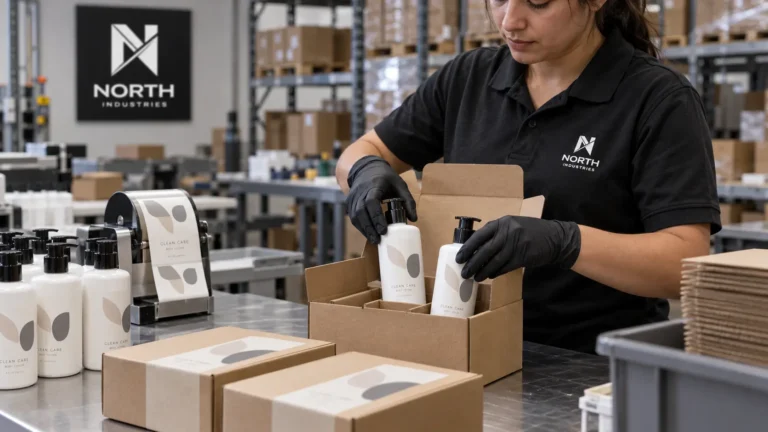
If you have a product that sells and you are trying to figure out how to get it made at scale, co-packing is probably the term you are looking for. Co-packing, also called contract packaging, is when a third-party company packages your product to your specifications, often filling, labelling, and assembling it as well, so you do not have to own the equipment or run the line yourself. This guide explains what co-packing is, how it differs from contract manufacturing and private label, when a brand needs it, what to prepare before you reach out, and what a first engagement looks like.
The short version
- Co-packing, also called contract packaging, is when a third-party company packages your product to your specifications, often filling, labelling, and assembling it too, so you don’t buy your own equipment, lease a facility, or hire a production team.
- Co-packing, contract manufacturing, and private label are not the same thing. The difference comes down to who owns the formula and who actually makes the product.
- Most brands reach for a co-packer when demand outgrows what they can make by hand, or when a retailer needs volumes they cannot fill themselves.
- MOQ, or minimum order quantity, is the smallest run a co-packer will accept. It varies widely, and some operators take small-batch, or pilot runs.
- Certifications depend on your category. Food, beverages, and supplements carry strict requirements you must verify with any co-packer, while cosmetics, household, and automotive liquids follow lighter rules.
What is co-packing, in plain language?
Co-packing is when a specialized company, called a co-packer or contract packager, prepares your product for sale on your behalf. You supply the product or its formula, and the co-packer fills, packages, labels, and readies it for retail or e-commerce. It lets a brand scale production without owning the equipment, space, or labour.
The name is short for contract packing, and a co-packer effectively becomes the production arm of your business. Brands across beauty, personal care, household, automotive, pet care, food, and beverage all use co-packers so they can spend their time on the product and the selling rather than on running a packaging line.
What is the difference between co-packing, contract manufacturing, and private label?
The difference comes down to who owns the formula and who makes the product. A co-packer packages a product you supply or have made elsewhere. A contract manufacturer both makes and packages to your recipe. A private-label supplier already owns a stock formula and simply applies your brand to it, so the recipe is not yours.
The table below shows how the three models divide the work.
Model | Who owns the formula | Who makes the product | Who packages it |
Co-packing | You | You or a separate manufacturer | The co-packer |
Contract manufacturing | You | The manufacturer | The manufacturer |
Private label | The supplier | The supplier | The supplier |
In practice, these blur together, and one operator often provides more than one. A co-packer may also fill your bottles, and some, including North Industries, offer private-label support within non-food liquids and consumer packaged goods. If your product is a liquid, the closest related service is filling a finished formula into bottles at volume, which many brands need alongside co-packing.
What does a co-packer actually do?
A co-packer handles the hands-on work of turning bulk or unfinished goods into finished, sellable units. Typical tasks include filling containers, applying labels and barcodes, assembling kits and multipacks, shrink wrapping, and building retail-ready packaging. Some co-packers, particularly integrated operators, also store the finished inventory and ship the orders.
The specific work depends on your product, but it usually falls into a few buckets:
- Filling and bottling: putting your liquid, powder, or product into its final container.
- Labelling and relabelling: applying, correcting, or updating labels, barcodes, and product information.
- Kitting and assembly: combining items into kits, bundles, multipacks, or promotional and seasonal packs.
- Retail-ready packaging: preparing goods to meet a retailer’s presentation and compliance requirements.
- Rework and repackaging: fixing packaging errors or reboxing product that is already made.
For a closer look at how co-packing works for consumer brands in Ontario, including where it overlaps with warehousing and fulfillment, that service is covered separately.
What types of products use co-packing, and what certifications matter?
Co-packing is used across food, beverage, beauty, personal care, household, automotive, and pet categories, essentially any product sold in a bottle, jar, pouch, box, or multipack. What changes by category is certification. Food, beverages, and supplements carry strict regulatory requirements, while cosmetics, household, and automotive liquids follow lighter rules.
This is the part first-time founders most often miss, and getting it wrong is expensive. A facility cleared to fill cleaning products is not automatically cleared to fill something you ingest. Before you sign with any co-packer, confirm in writing that they hold what your category requires. Use this as a starting point, then verify current rules with the regulator, since requirements change:
- Food and beverages: a food-safe facility, a Safe Food for Canadians licence through the CFIA, and often HACCP or SQF programs.
- Natural health products and supplements: a Health Canada Site Licence, a Natural Product Number, and Good Manufacturing Practices.
- Cosmetics: Health Canada cosmetic requirements, including cosmetic notification.
- Household and consumer chemicals: consumer chemical safety rules, with safety data sheets and WHMIS obligations for hazardous formulas.
North Industries fills non-food liquids and consumer packaged goods, and supports food and beverage brands on the non-food-contact side, such as secondary packaging, labelling, and distribution. Whatever co-packer you consider, ask directly what certifications they hold for your product and confirm the requirements yourself.
When does a brand need a co-packer?
A brand needs a co-packer when demand outgrows what it can make by hand. The usual signals are running out of capacity in a home kitchen or rented space, landing a first large retail purchase order, or spending more hours producing than selling. At that point, outsourcing production is what frees you to keep growing.
Common trigger moments include:
- Outgrowing a garage, kitchen, or small production space.
- Winning a retail or chain purchase order you cannot fill yourself.
- A farmers’ market or local product moving into stores.
- A product selling faster than you can make it.
- Launching a new size, format, or product line.
One thing to expect: moving to commercial scale sometimes means adjusting your recipe or format so it can be produced efficiently at volume. A co-packer will flag that early, and it is a normal part of the shift from handmade to production.
Is your volume too small for a co-packer, and how does MOQ work?
Your volume may not be too small, but you should understand MOQ before you ask. MOQ, or minimum order quantity, is the smallest run a co-packer will accept, set to cover the fixed cost of setting up and changing over a line. It varies widely between operators, and some take small-batch, or pilot runs.
The reason MOQs exist is simple. Setup, changeover, and labour are largely fixed per run, so a co-packer spreads them across a minimum number of units to make the job worthwhile. A high minimum is what prices out a lot of early-stage brands. You can sometimes negotiate a lower one by showing real growth intent, and some operators, including North Industries, will discuss small-batch, trial, and pilot runs rather than turning away a brand for missing a large national minimum. Exact minimums depend on your product and container and are set when you get a quote, so treat “what is your MOQ” as the start of a conversation, not a pass-or-fail test.
What should you prepare before you contact a co-packer?
Before contacting a co-packer, prepare a clear picture of your product and your goals. Have your product description, formula or specifications, target volumes, packaging and labelling direction, timeline, and any regulatory requirements ready. The more specific you are, the faster a co-packer can tell you whether they fit and roughly what a run would involve.
A practical checklist before you reach out:
- Product and formula: what it is, what goes in it, and how it is made now.
- Container and packaging: the bottle, jar, or pack, and your artwork or label direction.
- Target volume: roughly how much you need, and how often.
- Timeline: when you need finished goods in hand.
- Regulatory needs: any certifications your category requires.
It is fine to arrive without every answer. A good co-packer will help you scope the gaps, and the vocabulary in this guide is enough to start the conversation with confidence.
What does a co-packing engagement look like, from inquiry to production?
A co-packing engagement usually moves through a predictable sequence. It starts with an inquiry and a review of your product and process, then a sample or trial run, a formal quote, your approval and a deposit, production scheduling, the run itself, and a final quality check before the finished goods ship or move into storage.
At North Industries, a co-packing or filling project typically runs like this: an initial inquiry, a review of your product and process, a sample or a meeting at the facility, an assessment of the labour and materials involved, a trial or test run where the product needs it, then a formal quote. Once you approve and place the deposit, the run is scheduled, produced, checked for quality, and delivered. Trial batches and line setup are commonly billed, since they take real time before a single finished unit exists, so factor that into your first budget.
How North Industries approaches co-packing
North Industries co-packs non-food liquids and consumer packaged goods from one Mississauga facility, and supports food and beverage brands with non-food-contact work such as secondary packaging, kitting, labelling, and distribution. The company works with growing brands without requiring a large national minimum, and keeps production, warehousing, fulfillment, and delivery under a single relationship.
The scope covers co-packing and manual co-packing, repackaging, kitting and bundling, multipack and variety-pack assembly, labelling and relabelling, shrink wrapping, and product rework, all for non-food liquids and CPG. The practical advantage for a founder is that it sits under one roof. When your product is co-packed, warehoused, and shipped from the same operation, you avoid trucking finished goods between a separate co-packer and 3PL and managing the handoff between them. You can see the full range of what North Industries fills, packs, and builds in one place. For regulated categories such as food, beverages, or supplements, we will tell you plainly what it can and cannot take on, and you should always confirm certifications before booking a run.
Frequently asked questions
- Do I need a co-packer if I make the product myself?
If you make your product yourself and can keep up with demand, you may not need a co-packer yet. It becomes useful when orders outpace your capacity, when a retailer requires volumes you cannot hit by hand, or when producing eats the time you need for selling, marketing, and growing the brand. - How do I find a co-packer for my product?
Start by matching co-packers to your product category and the certifications it requires, then shortlist by minimum run size, location, and whether they can also warehouse and ship. Industry directories, trade associations, and referrals all help. Confirm each candidate holds the certifications your category needs before you share your formula. - What does a co-packer charge?
Co-packers usually price in parts: a setup or changeover fee for each run, a per-unit filling or packing rate, and the cost of components such as bottles, caps, and labels. Because the setup fee spreads across the run, short runs cost more per unit. Published rates mean little, so get a quote against your real product and volume. - Can a co-packer also handle my warehousing and shipping?
Some can. An integrated operator can co-pack your product, store the finished inventory, and ship orders from the same facility, which removes the freight and coordination of moving goods between a separate co-packer and 3PL. North Industries runs co-packing, warehousing, fulfillment, and company-operated final-mile delivery under one roof.
Ready to talk it through?
If you have a product and you are weighing whether co-packing is the right next step, talk to North Industries about your co-packing needs or book a tour of the Mississauga facility. Bring your product, target volumes, and packaging goals, and the team will tell you plainly whether it is a fit.