
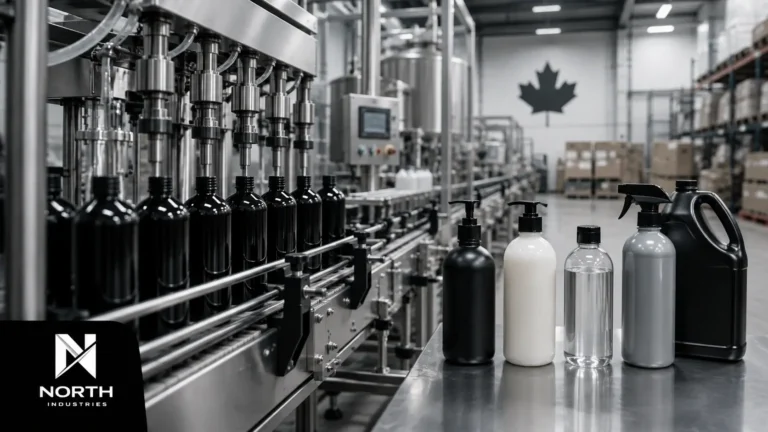
If you have a finished formulation and no practical way to fill it at volume, contract bottling in Ontario is how your product gets into bottles, labelled, and ready for retail or e-commerce without the capital cost of your own line. This guide is written for consumer brand founders, importers, and growing beauty, household, automotive, personal care, and pet brands deciding whether to outsource bottling, what it should cost, and how to choose a partner you can trust with your formula.
TL;DR
- Contract bottling is when a third-party facility fills your finished liquid into bottles, caps, labels, and packs it, so you do not have to buy or run a filling line.
- Cost in Canada usually combines a setup or changeover fee per run, a per-bottle or per-filled-unit rate, and the cost of components (bottles, caps, labels).
- Minimum runs are the biggest barrier for small brands; many lines will not take a first run below a set volume, though some, including North Industries, will discuss small-batch and pilot runs.
- Certifications matter by category: food, beverages, and supplements carry stricter requirements than cosmetics, household, or automotive liquids, so confirm what your product needs before you sign.
- One facility that bottles, labels, warehouses, and ships removes the double freight and two-vendor coordination that most brands pay for without noticing.
What is contract bottling and how does it work?
Contract bottling is a service where a manufacturer fills your product into its final container on your behalf. You supply the formulation (or have it made), the bottler runs it through a filling line, applies caps and labels, and hands back finished, sellable units. It removes the need to own equipment, hire a production team, or lease a facility.
A typical run moves through a predictable sequence. You confirm the formulation, container, and artwork. The bottler sources or receives your components, schedules the run, sets up and sanitises the line, fills and caps, applies labels, does quality checks, then cases and palletises the finished goods. From there the product either ships to you, goes to your retailers, or, in an integrated facility, moves straight into warehousing and fulfilment.
What types of liquids can be contract bottled?
Most thin-to-medium liquids and many creams, gels, and powders can be contract filled. The right process depends on viscosity, whether the product is heat-sensitive, and how it needs to be preserved. Filling a runny toner is a different job from filling a thick balm, and a bottler matches the equipment to the product.
Common categories North Industries and similar Ontario operators handle include:
- Beauty and wellness liquids: oils, serums, toners, micellar waters
- Personal care: shampoos, conditioners, lotions, gels, soaps
- Household and cleaning: sprays, concentrates, detergents, surface cleaners
- Automotive liquids: waxes, wash concentrates, detailing products
- Pet care: shampoos, sprays, grooming liquids
Fill methods vary by product. Thin liquids run on volumetric or overflow fillers, viscous products need piston or pump fillers, and powders use auger or gravity filling. If you want the filling side in more depth, we cover how fill methods are matched to each product separately.
How much does contract bottling cost in Canada?
Contract bottling in Canada is usually priced in three parts: a one-time setup or changeover fee for each run, a per-bottle or per-filled-unit rate, and the cost of components such as bottles, caps, and labels. North Industries quotes bottling on a per-bottle or per-filled-unit basis, or as a per-project quote, depending on the scope and complexity of the work.
The setup fee is what makes small runs feel expensive. Because it is a fixed cost spread across every unit in the run, it adds a lot per bottle on a short run and almost nothing on a long one. The variable per-unit filling cost barely moves. The table below shows the mechanic using a sample setup fee, not North’s rates, so you can see why volume changes the maths.
Run size | Sample setup cost spread per unit |
1,000 units | $4.00 |
10,000 units | $0.40 |
50,000 units | $0.08 |
Illustration using a sample $4,000 setup fee to show how fixed costs spread as volume rises. These are not North Industries prices. Sources: Eightx, US Continental Packaging, 2026.
Because true cost depends on your product, container, run size, and finishing, published rates online are close to meaningless for your specific job. The practical move is to get a quote against your real bottle, volume, and labelling.
What is the minimum order for contract bottling in Ontario?
Minimum order quantity, or MOQ, is the smallest run a bottler will accept. For contract bottling in Ontario, many lines set minimums in the thousands of units per run, and some will decline a first run below a threshold because the setup and changeover time is not worth it to them. This is the single biggest reason small brands struggle to find a partner.
North Industries takes a different position on smaller volumes. The facility supports small-batch production, trial runs, and pilot production, so an early-stage brand can start with a smaller, discussed run rather than being turned away for not hitting a large national minimum. If you are launching or testing a product, a smaller first run is a conversation, not an automatic no. Exact minimums depend on your product and container and are set at quote.
What certifications do you need for contract bottling?
Certification requirements depend entirely on your product category, and getting this wrong is expensive. Before you choose a bottler, confirm that the facility holds what your specific category requires, and ask them to show it in writing. A facility that fills cleaning products is not automatically cleared to fill something you ingest.
Use this as a starting checklist by category:
- Food and beverages: typically require a food-safe facility, Safe Food for Canadians licensing through the CFIA, and often HACCP or SQF programs
- Natural health products and supplements: require a Health Canada Site Licence, a Natural Product Number (NPN), and Good Manufacturing Practices
- Cosmetics: must meet Health Canada cosmetic requirements, including cosmetic notification
- Household and consumer chemicals: fall under consumer chemical safety rules, with SDS and WHMIS obligations for hazardous formulas
Confirm the certifications relevant to your category directly with any bottler you are considering, including North Industries, and verify current requirements with the relevant regulator, since rules change.
How do you choose a contract bottling company?
Choosing a contract bottling company comes down to fit, honesty, and whether they can grow with you. The cheapest quote often hides a rigid minimum, slow turnaround, or a facility that is not cleared for your category. Ask direct questions early and judge how straight the answers are.
Questions worth asking before you commit:
- What is your minimum run, and will you take a first or pilot run?
- How do you price: setup, per-unit, and components?
- What certifications do you hold for my product category?
- Do I supply bottles and caps, or do you source them?
- What is your lead time from approved artwork to finished goods?
- Can you also warehouse and ship, or do I move product to another vendor?
That last question matters more than most founders expect, which leads to the next two sections.
What is the difference between contract bottling and co-packing?
Contract bottling and co-packing overlap, but they are not the same. Contract bottling is specifically the act of filling your liquid into bottles and finishing them. Co-packing is the broader service of assembling, packaging, and preparing a finished product for sale, which can include bottling but also kitting, bundling, shrink-wrapping, and retail-ready packaging.
In practice, many brands need both, and a single operator often provides them together. If your product is a bottled item that also needs multipacks, inserts, or retail display packs, you are looking at bottling plus co-packing. For a fuller breakdown of that service, see what co-packing includes and what it costs.
Can one company bottle, label, store and ship your product?
Yes, and doing it under one roof is where the real savings sit. When you bottle at one facility and warehouse at another, you pay to truck finished goods between them, you manage two vendors, and you carry the risk in the handoff. Combining bottling with warehousing and fulfilment removes that double freight and the coordination tax that comes with it.
North Industries runs bottling, packaging, warehousing, third-party fulfilment, and company-operated final-mile delivery from one Mississauga operation. Finished bottles can move straight from the line into storage and out to customers without leaving the building or changing hands. That single-roof model spans everything North fills, packs and builds through to storing and shipping every order, which removes the second vendor and the freight leg between them.
How North Industries handles contract bottling in Mississauga
North Industries is a vertically integrated consumer-goods operator at 3186A Lenworth Drive in Mississauga, filling non-food consumer and industrial liquids across beauty, personal care, household, automotive, and pet categories. Bottling is one of the company’s core services, priced per bottle, per filled unit, or by project quote, with small-batch and pilot runs available for growing brands.
What tends to matter to founders is the practical side. You deal with the people running the floor, not a call centre. Finished goods can go straight into warehousing and ship on North’s own delivery vehicles across the GTA, so one relationship covers filling through to final-mile delivery. For regulated categories such as food, beverages, or supplements, confirm certification requirements directly before booking a run, and North will tell you plainly what it can and cannot take on.
Frequently asked questions
- How long does a contract bottling run take?
Timing depends on your components, run size, and the bottler’s schedule. Once artwork is approved and bottles, caps, and labels are on hand, a straightforward run is often completed within days of its scheduled slot. Sourcing custom components is usually the longest part, so confirm lead times before you commit. - Do I need to provide my own bottles for contract bottling?
You can supply your own bottles and caps, or have the bottler source them. Supplying your own gives you control over the exact container and can save cost if you already have supplier relationships. Having the bottler source components is simpler and useful when you want one point of contact for the whole run. - Can a contract bottler also handle my labelling and packaging?
Most contract bottlers apply labels as part of the run, and many also offer packaging, kitting, and retail-ready prep. Confirm this upfront, because a bottler that stops at filling leaves you to arrange labelling and packaging separately, which adds cost, time, and another vendor to manage. - What is the difference between contract bottling and contract filling?
The terms are often used interchangeably. Contract filling refers to the act of putting product into a container, while contract bottling specifically means filling into bottles. In everyday use, a brand asking for either is usually after the same outcome: finished, filled, labelled units ready to sell. - Will a contract bottler keep my formulation confidential?
Reputable bottlers protect client formulations and will sign a non-disclosure agreement before you share sensitive details. Ask for one early. If a facility hesitates to sign an NDA or discuss confidentiality before a run, treat that as a signal about how they will handle the rest of the relationship.
Ready to bottle your product?
If you are planning a launch or scaling a product that is already selling, North Industries can bottle, label, store, and ship it from one Mississauga facility, with room to start small. Request a bottling quote with your product, container, and target run size, or book a tour to see the line before you commit.