
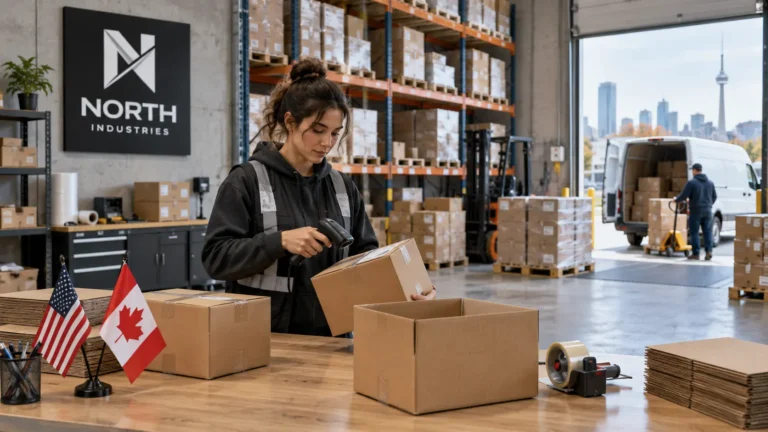
If you run a US consumer brand and watch Canadian customers fill a cart then vanish at checkout, the problem is almost always the border. Shipping individual orders from a US warehouse into Canada is slow, the fees surprise your buyer at delivery, and your team burns hours it does not have on customs questions. Setting up warehousing and fulfillment in Canada removes that friction by positioning inventory in-country before the sale. This guide walks a US brand through the border rules as they stand in 2026, the tax and registration steps, the three market entry models, and how to choose a Canadian partner.
The short version
- US brands lose Canadian sales at the border, not because of one rule change, but because cross-border parcels arrive slowly, carry surprise duties and taxes at the door, and push Canadian shoppers to abandon their carts.
- The reliable fix is holding inventory inside Canada, which turns every Canadian order into a domestic shipment with domestic speed and pricing.
- Section 321 is a US import rule. It governs goods entering the United States, not the parcels you send into Canada. Parcels into Canada follow Canada’s own CUSMA thresholds of CAD $40 for tax and CAD $150 for duty.
- You do not need a Canadian company to warehouse and sell here, but storing inventory in Canada usually means registering for GST/HST. Confirm your situation with a customs broker or a cross-border tax advisor.
- The Greater Toronto Area is the practical entry point, and the cleanest setup is one partner that receives your inventory, stores it, fulfills orders, and delivers, all under a single relationship.
Why does cross-border shipping into Canada cost US brands sales?
Cross-border shipping costs US brands sales because Canadian customers face three problems at once: slow delivery from a US warehouse, unexpected duties and taxes collected at the door, and higher shipping prices than a domestic order carries. Each one raises cart abandonment, and together they make a US storefront feel unwelcoming to Canadian buyers.
The pain shows up in the buyer’s own words. Across seller forums, US brands describe Canadian customers being hit with unexpected duties and taxes when a parcel arrives, then refusing or abandoning it rather than paying. When an order ships with duties unpaid, the carrier can hold the parcel until the customer settles the charges, adding a collection surcharge on top, and refused parcels come back to you at your cost. That is why a large share of Canadian carts never convert. It is not a pricing objection you can discount away. It is a border experience problem, and the way to fix it is to take the border out of the customer’s transaction.
What actually changed in 2025 for US brands, and what didn’t?
What changed in 2025 was the United States ending its own de minimis exemption, which affects goods entering the US, not the parcels you ship into Canada. What did not change are Canada’s import thresholds. If you have read that Section 321 broke shipping into Canada, that is a common misreading worth clearing up before you plan anything.
Section 321 refers to a US customs provision that let parcels under USD $800 enter the United States duty-free. That exemption ended for China on May 2, 2025, and for all other countries on August 29, 2025, and a 2027 law makes the repeal permanent. It touches your business in two places: the goods you import into the US, and any Canadian returns coming back across the border, both now dutiable. It does not govern the parcels you send to Canadian customers.
Goods entering Canada follow Canada’s thresholds under CUSMA, which have been stable since the agreement took effect. For a courier parcel from the US, under CAD $40, no duty or tax is collected; from CAD $40 to $150, the parcel is duty-free, but Canadian sales tax applies; and over CAD $150, both duty and tax can apply. Most US-made goods still enter duty-free under CUSMA origin rules, so duty mainly bites on goods made outside North America, such as apparel. Postal parcels sent through Canada Post fall under a lower CAD $20 tax threshold. Add the tariff volatility of the past year, which raised landed-cost uncertainty in both directions, and the picture is clear: cross-border parcels into Canada were never cheap or predictable, and they got harder. Holding inventory in Canada sidesteps the whole question.
What are the three ways a US brand can enter the Canadian market?
A US brand can serve Canadian customers three ways: keep shipping cross-border parcel by parcel, use a bonded warehouse to defer duty on goods it plans to re-export, or hold inventory in-country with a Canadian 3PL and fulfill domestically. Most direct-to-consumer brands land on in-country inventory once Canadian volume justifies it. The models differ in cost, speed, and how much commitment they ask for.
Model | How it works | Best for | Main trade-off |
Cross-border parcel | Ship each order from the US; the buyer clears it at delivery | Very low Canadian volume, testing demand | Slow transit, surprise fees, high cart abandonment |
Bonded warehouse | Store imported goods with duty deferred until they leave; suited to goods that will be re-exported | High-value goods and re-export flows | Defers duty, does not remove it; added complexity; a poor fit for plain domestic DTC |
In-country inventory | Import in bulk once, clear at import, store in Canada, fulfill domestically | Steady Canadian demand across DTC and B2B | Requires GST/HST registration and an inventory commitment |
A word on the bonded option, because it is often misunderstood. A bonded or sufferance warehouse lets you hold imported goods with duty deferred while they wait to be re-exported. If you are selling to Canadians, the goods stay in Canada and clear for domestic use anyway, so bonded storage rarely earns its complexity. North Industries operates the in-country model, not a bonded facility, which is the right fit for a brand whose Canadian orders are staying in Canada.
Why does in-country warehousing win on cost, speed, and customer experience?
In-country warehousing wins because it converts an international shipment into a domestic one. You import inventory in bulk and clear it a single time, then every Canadian order ships at domestic rates and speeds, with no duty or brokerage collected at the customer’s door. That removes the three friction points that drive Canadian cart abandonment in one move.
Clearing a bulk import once is also more predictable than clearing hundreds of individual parcels, since commercial imports follow an established process rather than surprising each customer at delivery. Delivery times drop to what a Canadian shopper expects from a domestic store. Checkout shows a clean, all-in price with no fee waiting at the door. Returns are received and processed inside Canada instead of making a cross-border round trip. And the same Canadian inventory can feed both your DTC orders and any B2B shipments to Canadian retailers or marketplaces, so one stock pool serves every channel.
How do Canadian customs, duty, and GST/HST work for your inventory?
Bringing inventory into Canada makes your business the importer of record, responsible for clearing goods through the Canada Border Services Agency and paying any duty and GST at the border. Storing that inventory in Canada also generally triggers GST/HST registration. None of this requires a Canadian company, but it does require a few registrations, and it is worth getting right before your first container ships.
The pieces fit together like this. You register for a Canadian Business Number with an import/export account and a GST/HST account, which lets you act as importer of record and reclaim tax. You do not need to incorporate a Canadian entity, and non-residents now register through a digital process with the Canada Revenue Agency. Storing inventory in Canada is treated as carrying on business, which brings registration into play from the start rather than only after you cross a sales threshold, and the carrying-on-business test turns on several factors, not one. The general small-supplier line for non-resident vendors is CAD $30,000 in taxable sales over four consecutive quarters. Once registered, you charge GST/HST at the applicable provincial rate, remit it, and recover the GST you paid at the border through input tax credits. Clearance itself runs through CARM, the CBSA’s current system of record for commercial importers, usually with a licensed customs broker handling the entry.
This section is general information, not legal or tax advice. Import and tax obligations depend on your products and your facts, so confirm your setup with a Canadian customs broker and a cross-border tax advisor before you import.
How should a US company choose a Canadian 3PL partner?
A US company should choose a Canadian 3PL on four things: whether it will onboard a brand at your current volume, how it handles inbound imports, whether it can serve both DTC and B2B from one inventory pool, and how directly you can reach the people running your account. Price matters, but fit and communication decide whether the relationship holds up.
- Minimums that match your stage. Many national providers will not onboard brands under roughly 1,000 to 3,000 orders a month, so a partner that starts smaller lets you test Canada before committing heavy inventory.
- Inbound import handling. Ask how they receive a container or bulk freight, whether they unload and palletize floor-loaded goods, and how receiving is counted and documented.
- DTC and B2B from one pool. Confirm they can ship direct to consumers and to retailers, distributors, and marketplaces without splitting your stock across systems.
- Integration and reporting. Check the ecommerce and inventory connections so orders and stock levels flow without manual re-keying, and understand how the cost of a Canadian setup is structured before you compare quotes.
- Direct access. Decide how much it matters to reach a decision-maker quickly when a shipment or a customer issue needs a fast answer.
What should a Canadian 3PL actually do for a US brand?
A Canadian 3PL for a US brand should receive your imported inventory, store it, fulfill Canadian DTC and B2B orders, handle returns, and deliver, ideally under one accountable relationship. The customs clearance itself is your step as importer of record, which a 3PL can coordinate through a broker but does not replace.
On the Canadian side, the work runs from the dock to the doorstep. The provider receives and unloads your container, palletizes floor-loaded goods, stores the inventory, then picks, packs, and ships each order, with returns received and processed domestically. What sits outside the 3PL’s hands is the clearance and importer-of-record step, which belongs to you and is usually handled by a licensed customs broker. North Industries coordinates cross-border freight and works alongside a broker on clearance rather than acting as your customs broker or a bonded facility, so the division of responsibility stays clear. For visibility, your Canadian fulfillment operation connects to your store through a system with direct reporting on orders and stock, rather than a separate self-serve portal.
Why is Mississauga and the GTA the right place to warehouse inventory in Canada?
Mississauga and the wider Greater Toronto Area are the right entry point because they put your inventory within one day’s ground transit of roughly a third of Canada’s population, next to the country’s largest air-cargo airport, and close to the busiest US border crossings. That reach lets a single location cover most of your Canadian demand at domestic speeds.
The GTA sits at the junction of Highways 401, 407, and the QEW, hosts Pearson as Canada’s largest air-cargo airport, and is served by CN’s Brampton and CPKC’s Vaughan intermodal terminals, which is how ocean containers landing at coastal ports reach the region by rail. It is also about 90 minutes from the Buffalo-Niagara and Detroit-Windsor crossings, the two highest-volume freight lanes on the Canada-US border, which keeps inbound import options and any US-bound flows short. North Industries operates from 3186A Lenworth Drive in Mississauga, inside that corridor.
How does North Industries support US brands entering Canada?
North Industries supports US brands entering Canada by receiving imported inventory at our Mississauga facility, storing it, fulfilling Canadian DTC and B2B orders, and delivering through our own vehicles across the GTA, all under one relationship. We onboard growing brands below the volumes most national providers require, so you can test the Canadian market without overcommitting inventory.
That flexibility is the practical difference for a brand in its first year here. We generally work with storage clients needing roughly 150 to 200 square feet or a meaningful number of pallet positions, and fulfillment clients with recurring monthly orders, which is well under the floors larger providers set. Because manufacturing, packaging, warehousing, fulfillment, and company-operated final-mile all sit inside one accountable operation, you coordinate with one team from the container to the customer instead of stitching together separate vendors. We have handled cross-border fulfillment across both Canadian and US orders, and completed a product rework project of roughly 100 pallets for a major Canadian airline. Order and inventory reporting connects through Zoho Inventory and Shopify, so you keep visibility without managing another portal.
Frequently asked questions
- How do I set up a warehouse in Canada as a US company?
You do not open a Canadian entity. You register for a Business Number with import/export and GST/HST accounts, arrange customs clearance as importer of record through a broker, then ship inventory in bulk to a Canadian 3PL that receives, stores, and fulfills your orders. Confirm the tax steps with a cross-border advisor first. - Does the end of Section 321 de minimis affect shipping into Canada?
No. Section 321 is a United States import rule that ended the USD $800 duty-free exemption for goods entering the US. It does not govern the parcels you ship into Canada. Shipments into Canada follow Canada’s own CUSMA thresholds, which are CAD $40 for tax and CAD $150 for duty on courier parcels. - Do I need a Canadian business number to warehouse inventory in Canada?
In practice, yes. To import as the importer of record and to register for GST/HST, you need a Canadian Business Number with the matching program accounts. You do not need to incorporate a Canadian company to obtain one. A customs broker or tax advisor can confirm exactly which accounts your setup requires. - What is the best city in Canada to warehouse inventory?
For most brands, the Greater Toronto Area, and Mississauga in particular, is the practical choice. It reaches about a third of Canada’s population within a day’s ground transit, sits beside Canada’s largest air-cargo airport, and is close to major US border crossings, so one location covers most Canadian demand at domestic delivery speeds. - How does GST/HST work for US companies selling in Canada?
A US company storing inventory in Canada is generally treated as carrying on business, registers for GST/HST, charges the applicable provincial rate, and remits it to the Canada Revenue Agency. Registered importers recover the GST paid at the border through input tax credits. The carrying-on-business test is multi-factor, so verify your obligations with an advisor. - Can a Canadian 3PL handle customs clearance for imported US goods?
A Canadian 3PL receives, stores, and fulfills your goods once they are in Canada, but clearing customs is the importer of record’s responsibility, usually handled through a licensed customs broker. North Industries coordinates cross-border freight and works with brokers on the clearance step. We are not a customs broker or a bonded warehouse. - How do I fulfill Canadian ecommerce orders from a Canadian warehouse?
You connect your store to your 3PL so orders flow automatically, then the warehouse picks, packs, and ships each order domestically at Canadian rates and speeds. North Industries works with Shopify and other platforms through Zoho Inventory, giving you connected order and inventory reporting rather than a separate self-serve portal. - Can I send unsold inventory back to the US?
You can, though it is not free. Returning goods to the United States is now a dutiable import on the US side since the de minimis exemption ended, so plan for a customs entry and any duty when you model a return. Many brands instead redeploy slow-moving inventory through Canadian retail or marketplace channels.
Ready to plan your Canadian setup?
If you are mapping out a Canadian launch and want to see how the receiving-to-delivery flow would work for your products, book a Canadian market entry consultation or a tour of our Mississauga facility. We will match the setup to your volume and SKU count and show you where your inventory would sit.