
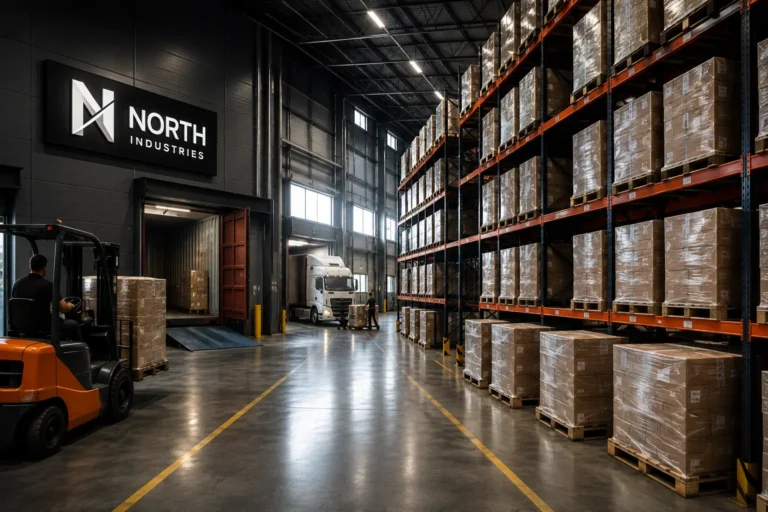
If you are an importer with a container arriving, a Shopify brand that has outgrown a spare room, or a U.S. company trying to serve Canadian customers, a 3PL in Mississauga is the warehouse that receives your inventory and ships your orders for you. This guide explains what that actually covers, how pricing really works in the GTA, and the questions that separate a partner you keep from one you spend next spring trying to leave.
TL;DR
- A 3PL stores your inventory and picks, packs, and ships your orders. “3PL” covers everything from bare storage to a full production-to-delivery partner, so confirm which one a quote is actually for.
- Mississauga holds so much of Canada’s inventory because it sits on Highways 401, 403, 407 and 427, wraps around Pearson, and reaches most of the country within one to two days.
- Pricing is a component model: storage, receiving, pick-and-pack, value-added work and freight are billed separately. Judge the total landed cost per order, not any single line.
- The hidden fees are the ones left off the quote. Ask for a full rate card and what is excluded before you sign.
- North Industries fills, packages, stores, ships, and delivers from one Mississauga facility, so you replace four vendors with one accountable team.
What is a 3PL, and what does it include?
A 3PL (third-party logistics provider) is a company you hand your inventory to, so it can store your goods, pick and pack customer orders, and ship them on your behalf. The word covers three very different things, and the gap between them is where buyers get burned:
- Storage only. Holds your pallets and little else.
- A fulfillment centre. Picks, packs and ships parcels, but may not touch freight, retail orders or bulky goods.
- A full-service 3PL. Receives inbound shipments, stores them, fulfills both direct-to-consumer and business-to-business orders, handles returns, and coordinates freight and delivery.
Some operators, North Industries among them, also handle the steps that happen before fulfillment: filling, co-packing, and product rework. That lets a product move from production to the customer under one relationship instead of four. The practical takeaway: a storage quote and a fulfillment quote can look alike on paper and behave nothing alike once your goods are in the building, so get clear on which you are buying before you compare numbers.
Why is Mississauga the GTA’s logistics hub?
Mississauga is where Canadian inventory concentrates, and the reasons are physical, not marketing:
- Highways. It sits at the intersection of the 401, 403, 407 and 427, so trucks depart faster than from congested downtown Toronto.
- Air and rail. It wraps around Toronto Pearson, Canada’s leading air-cargo gateway, with direct reach to CN and CP rail yards.
- Border and reach. The U.S. crossings at Fort Erie, Niagara and Windsor are roughly two hours away, and ground shipments reach most of the Canadian population within one to two days.
This is also why “3PL near Toronto” and “3PL Mississauga” point to the same market. The warehousing gravity settled in Mississauga, Brampton, and the 905 belt because that is where the infrastructure and the affordable industrial space are. North Industries operates from 3186 Lenworth Drive in the eastern Dixie and QEW corridor, with quick access to the 427, the QEW, and Pearson. For an importer, that means shorter drayage from the port terminals; for a national shipper, it means most of the country is a day or two out by ground.
How does 3PL pricing work, and what does it cost?
3PL pricing is a component model. You do not pay one flat fee; you pay for each activity your inventory triggers. Once you know the components, quotes stop reading like a foreign language. Here is each activity, with typical 2026 Canadian market ranges for context. Treat these as planning ranges, not any provider’s rate card:
- Storage. Billed per pallet position or per square foot, monthly. Canadian racked pallet storage averages in the mid-teens per pallet, and GTA rates sit toward the higher end of that national range because Toronto-area industrial space is among the country’s most expensive.
- Receiving and unloading. Per pallet or per carton to unload and check inbound goods. Container unloading and palletization are usually separate lines. Clean, labelled pallets should be billed per pallet, not by the hour.
- Pick and pack. A base fee for the first item plus a smaller charge per additional item. B2C orders usually run a few dollars each; B2B runs higher because it involves cases and pallets.
- Value-added work. Labelling, kitting, assembly, filling and rework, billed per unit, per filled bottle, or per labour hour.
- Freight and final-mile. Charged by distance, shipment size and service level.
- Account minimum and deposit. A monthly minimum where it applies, and often a first-and-last-month deposit to reserve storage space.
That last group is North Industries’ actual pricing structure, and we quote it line by line against your inventory volume, order volume, SKU count, handling and delivery needs. You can see how our fulfillment service is set up and request a quote from there. Once storage, receiving and pick-and-pack are stacked together, the all-in cost of a standard ecommerce order commonly lands between roughly $8 and $18 before the carrier’s shipping charge. The figure that matters is the total, not any single line.
One GTA-specific point: many national 3PLs will not onboard an account below a 25 to 50 pallet minimum. North generally works with clients needing roughly 150 to 200 square feet or a meaningful number of pallet positions, which is well under that floor. That flexibility is exactly what a growing brand or a national provider would turn away tends to need.
What hidden 3PL fees should you watch for?
The most common complaint in the category is that the first invoice looks nothing like the quote. It is rarely fraud; it is usually fees that were real all along but sat in a footnote. The ones to ask about:
- Inbound receiving charges left out of the headline number
- Long-term storage surcharges
- Account setup fees
- Fuel and peak-season surcharges (Toronto Q4 surcharges of 20 to 25% are common)
- Non-standard packaging fees
- Returns handling
- Minimum shortfall charges when your volume dips
- Pallet movement fees
- Technology or WMS access fees
None of these are automatically unreasonable. The problem is opacity, and the fix is one question: ask for a complete, line-by-line rate card, then ask specifically what is not included. How plainly a provider answers tells you how they will behave once your goods are in the building.
What should you ask a 3PL before signing?
Six questions filter most of the market:
- What is your complete fee schedule, and what falls outside it?
- What is your account minimum, and how is a shortfall billed?
- Who is my point of contact after I sign, a person or a ticket queue?
- How do you handle inventory counts and discrepancies, and how often do you reconcile?
- Can you run DTC, wholesale, and marketplace orders from the same inventory, and do you integrate with my store?
- What does your contract say about releasing my inventory if I leave?
That last one matters most. A fair agreement states plainly how and when you can retrieve your own goods. The time to read that clause is before you sign, not during a dispute.
What are the red flags a 3PL will fail you?
These are drawn from what brands consistently report after a relationship goes wrong:
- Communication runs through a ticket system and never a person.
- Invoices are longer and more surprising than your order sheet.
- Inventory counts never match your own records.
- Orders are “always” a little late while nothing is ever officially wrong.
- Service collapses during peak season.
- The salesperson who sold you the contract disappears the moment you sign.
One of these is a bad week. Several at once is a pattern, and the pattern rarely fixes itself.
How is North Industries’ integrated model different?
Most GTA operators do one slice of the chain. You buy storage from one, fulfillment from another, packaging from a third, and delivery from a courier, then spend your week coordinating between them. North Industries removes that vendor sprawl by running the whole chain from one Mississauga facility:
- Receiving and unloading containers, then palletizing and storing the inventory
- Filling, packaging, co-packing and product rework
- DTC, wholesale and Amazon order fulfillment
- Local and regional final-mile delivery in company-operated vehicles
That means one accountable team from production through delivery, direct access to the people actually running your account, and quotes built around the work your business genuinely needs. It also scales to one-off projects, including a recent product rework job of roughly 100 pallets.
We are candid about fit. North is a flexible regional partner, not a national network with dozens of warehouses. If you need multi-city distribution centres or a certification we do not hold, we will say so rather than overpromise. For most GTA importers, ecommerce brands and consumer-goods companies, that flexibility and direct accountability is the thing that has been missing.
Frequently asked questions
- How long does it take to set up with a new 3PL?
A storage-only account can go live in days. A full fulfillment account usually takes two to six weeks, depending on integrations, SKU complexity, and inbound scheduling, and normally includes a test order before you go fully live so the setup is proven before customers are affected. - What is the minimum order volume for a 3PL in Ontario?
It varies widely. Many national providers will not onboard below roughly 25 to 50 pallets or a set monthly order count. Flexible regional operators serve smaller volumes; North generally works with clients needing about 150 to 200 square feet or a meaningful number of pallet positions. - Can a small business use a 3PL in Canada?
Yes, though large 3PLs often set pallet or order minimums that rule out early-stage brands. A flexible regional operator can usually serve a growing business a national network would decline, which is the gap a Mississauga-based partner like North Industries is built to fill. - What should be included in a 3PL contract?
At minimum: the complete fee schedule, your account minimum and how shortfalls are billed, receiving and shipping cut-offs, how inventory counts and discrepancies are handled, insurance responsibility for your goods, and the terms under which you can retrieve your inventory if you decide to leave. - How do I find a 3PL near Toronto?
Most GTA warehousing sits in Mississauga, Brampton, and the surrounding 905, not downtown Toronto, because that is where the highway, air, and rail infrastructure is. Prioritize highway and Pearson access, transparent pricing and direct communication over a downtown postcode.
See what a straight answer looks like
You have done the research most buyers skip, so you already know the difference between a warehouse and a partner. North Industries will give you a line-by-line quote on your real volume and an open invitation to tour the Mississauga facility before you commit a single pallet.