
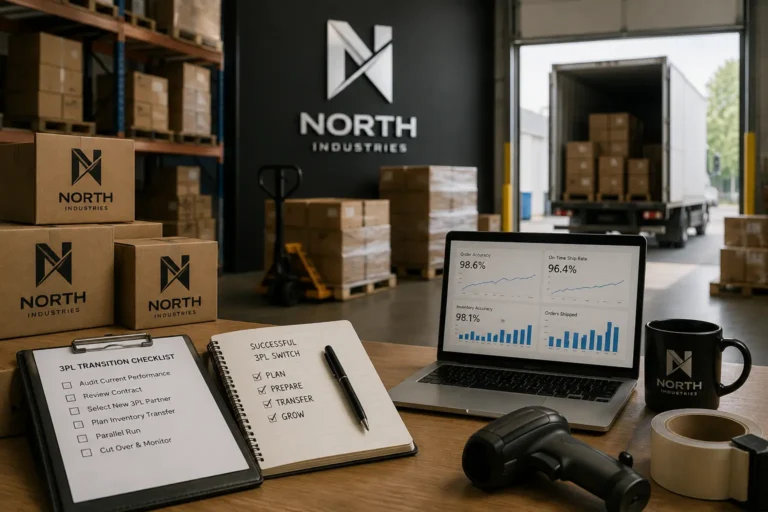
Switching 3PL providers in Canada feels like moving houses while the shop stays open, which is why so many brands stay with a provider that is already failing them. The disruption you are picturing, orders freezing and customers left waiting, comes from switching badly, not from switching. This guide is for brand owners who have decided their current 3PL is not working and need to change fulfilment company without the move blowing up their customer experience. It walks the decision, the timing, the inventory transfer, and the cutover, step by step.
TL;DR
- Switching your 3PL is common and survivable. Roughly 38% of brands change fulfilment providers each year, a figure Shopify reported in 2022, so you are not doing anything unusual.
- The fear is disruption, and the way you avoid it is a parallel run: your new provider starts receiving and shipping before the old one fully stops.
- Timing is the biggest lever. Switching mid-peak or during a major promotion is where brands actually get hurt, so plan around your calendar.
- Read your current contract first, specifically the notice period and the terms covering release of your inventory, before you give notice.
- A clean switch usually takes a few weeks, driven mostly by how fast inventory moves and how organised your data is.
How do you know it’s time to switch 3PLs?
You know it is time to switch when the problems are structural, not occasional. Every 3PL has an off week. What signals a real move is a pattern: repeated mis-picks, inventory counts that never reconcile, support that goes quiet when something breaks, and costs that keep creeping without explanation. One bad month is noise. Three months of the same failures is a trend.
Watch for these recurring signs that leaving your 3PL is the right call:
- Order accuracy keeps slipping, and error rates are trending up, not down
- Inventory records do not match reality, so you oversell or hold phantom stock
- Support is slow or defensive when you raise issues, rather than fixing them
- Costs rise without a clear reason, or surprise fees keep appearing
- They cannot support your growth, whether that is new channels, SKUs, or volume
If you recognise a persistent problem in our list of warning signs a 3PL is failing, the question shifts from whether to leave to how to leave cleanly.
How do you switch 3PL providers?
Switching 3PL providers follows five stages, and running them in order is what keeps the move controlled. Rushing straight to a new contract without auditing or planning the cutover is how brands end up with frozen orders. The stages are decide, audit, choose, transition, and cut over, and each one reduces the risk in the next.
Here is the high-level path:
- Decide and document: confirm the problems are structural and note what you need fixed
- Audit your current provider: pull your performance data and read your contract
- Choose your next 3PL: shortlist, ask the hard questions, and check the red flags
- Plan the transition: set the timeline, the inventory move, and a parallel-run window
- Cut over: shift new orders to the new provider once it is receiving and shipping
The rest of this guide takes the stages that carry the most risk, auditing, timing, transfer, and the contract, one at a time.
How to audit your current 3PL before you leave
Auditing your current 3PL before you leave gives you two things: proof you are making the right call, and a benchmark to hold the next provider to. Pull the numbers rather than relying on how it feels. The goal is a clear picture of performance and cost that you can hand to candidates and say, do better than this.
Gather the hard data before you give notice:
- Order accuracy and on-time ship rates over the last three to six months
- Inventory accuracy, including shrinkage and reconciliation gaps
- Your true all-in cost per order, with every fee included, not just pick-and-pack
- Your current inventory on hand, counted and reconciled, so nothing goes missing in the move
- Your contract terms, especially notice period and inventory-release conditions
That last point matters most, because the contract dictates how and when you can leave. Read it before you talk to anyone new.
When is the worst time to switch 3PLs?
The worst time to switch 3PLs is during your peak season or a major promotion, when order volume is highest, and any disruption hits the most customers. Moving inventory and cutting over systems always carries some risk, and you do not want that risk landing during Black Friday, the December rush, or a product launch you have been building toward.
Plan the switch for a quieter window instead. For most consumer brands, that means late winter or a mid-year lull, when daily volume is lower and a short transition gap, if one happens at all, affects fewer orders. If your current provider is failing so badly that staying through peak is the bigger risk, switching still beats sinking, but go in with a parallel run and extra buffer stock. The rule of thumb: switch when a mistake would cost you the least.
How to choose your next 3PL
Choosing your next 3PL comes down to proof and fit, not the pitch. Any provider can say the right things on a sales call. What protects you is asking for evidence and watching for the warning signs that predict the same problems you are trying to escape. You already have a benchmark from your audit, so use it.
Ask every candidate:
- What are your published accuracy and on-time rates, and will you put them in the contract?
- How do you price, all in, including receiving, storage, pick-and-pack, and returns?
- How do you handle a transition in, and have you onboarded brands mid-contract before?
- Where are you located relative to my customers and my inbound freight?
- How do I reach a human when something goes wrong?
Treat these as red flags: vague answers on error rates, pricing that hides fees until the invoice, no clear onboarding process, and reluctance to commit performance terms to writing. If a provider is evasive while trying to win you, that rarely improves once you are locked in. For a broader comparison of what a strong provider looks like, our guide to 3PL in Mississauga and our ShipBob alternative breakdown are useful reference points.
How do you transfer inventory between 3PLs?
You transfer inventory between 3PLs with a parallel run, which means your new provider is set up, stocked, and shipping before the old one goes dark. This is the single technique that prevents the nightmare of orders stopping mid-switch. Instead of a hard cut where everything moves at once, you overlap the two providers for a short window so there is never a moment when no one can ship.
A controlled transfer runs in this order:
- Set up the new provider first: accounts, integrations, and SKU data loaded and tested
- Send a buffer of inventory to the new 3PL while the old one still ships live orders
- Test with real orders, routing a small volume to the new provider to confirm it works
- Move the bulk of inventory on a scheduled date, ideally reconciled at both ends
- Cut over new orders to the new provider, then wind the old one down
The handoff of the first live orders is the delicate part. Keep a buffer of stock at the new site early, so the moment you flip the switch, it can ship without waiting on the main inventory move to finish.
What if your current 3PL holds your inventory?
If your current 3PL will not release your inventory, the issue is almost always the contract and any outstanding balance, not a legal grey zone you cannot navigate. In Canada, a warehouse can place a lien on stored goods for legitimate unpaid storage or handling charges, which is why the cleanest protection is to clear valid balances and follow your contract’s exit terms before you start moving inventory. Read the release conditions in your agreement early, because that is where your leverage lives.
To lower the risk of a difficult exit:
- Settle legitimate outstanding charges so there is no valid basis to withhold goods
- Give notice exactly as the contract requires, in writing, keeping records
- Ask for a written release and handoff schedule rather than a verbal promise
- Look for fair terms in any future contract, including clear inventory-release language on exit
Some sellers do report providers becoming difficult or slow to release goods once notice is given, which is exactly why transparency on exit terms should be something you check upfront. North Industries sets out how it handles your inventory and account in its published policies, which you can review on the North Industries policy page. This section is general information, not legal advice; for a specific dispute, check your contract and speak to a qualified professional.
How long does a 3PL switch take?
A 3PL switch usually takes a few weeks from decision to full cutover, though the range is wide depending on your inventory size and how clean your data is. A small catalogue with tidy SKU data and a nearby new provider can move in one to two weeks. A large, multi-SKU operation with a cross-country inventory move takes longer, often four to six weeks, because the physical transfer and reconciliation set the pace.
The two things that slow a switch most are messy inventory data and freight distance. If your SKUs, counts, and product information are disorganised, the new provider spends time cleaning them before it can ship accurately. Getting your data in order before you start is the cheapest way to shorten the whole timeline.
How North Industries takes over a 3PL switch
North Industries is built to be the parallel-run destination that keeps your orders moving during a switch. Because receiving, warehousing, fulfilment, and final-mile delivery all sit under one roof at its Mississauga facility, there are fewer handoffs to break during the transition, and the new operation can be tested with live orders before you commit the bulk of your inventory.
Three things make the cutover lower-risk here. North runs its own delivery vehicles across the GTA, so the first shipments do not depend on a third-party carrier turning up on the right day. The onboarding process is transparent, with direct access to the operations team rather than a ticket queue, so you can see your inventory and orders during the move instead of chasing a black box. And because North takes on growing brands rather than only large accounts, a mid-contract switch is a normal request, not an exception. You can see the wider operation on the third-party logistics and fulfilment page.
Frequently asked questions
- How much does it cost to switch 3PL providers?
Switching costs vary, and the figure that surprises brands is not the setup fee but the overlap. During a parallel run, you may pay both providers briefly, plus freight to move inventory and any onboarding charges. Read your current contract for early-termination fees too. The cost of switching is usually far smaller than the cost of staying with a failing provider. - What are my rights if my 3PL loses or damages my inventory?
Your rights depend on your contract and the liability terms it sets, which is why those clauses matter when you sign. Most agreements define the provider’s responsibility for loss or damage and any caps on it. Document the discrepancy with your own records, raise it in writing, and if it is significant, seek qualified advice. This is general information, not legal advice. - Do I have to give my current 3PL notice before leaving?
Usually yes. Most 3PL contracts require written notice, often 30 to 90 days, before you can end the agreement or remove inventory without penalty. Check your notice period before you line up a new provider, because it sets your earliest realistic switch date and helps you avoid triggering avoidable fees. - Will my orders keep shipping during the switch?
They can, if you run the two providers in parallel rather than cutting over all at once. The new 3PL holds a buffer of inventory and begins shipping live orders before the old provider stops, so there is no gap. Orders only freeze when brands do a hard cut with no overlap, which is the scenario a parallel run is designed to prevent.
Ready to make the switch without the chaos?
If you have decided to leave your current provider, the safest next step is a plan, not a leap. North Industries can map the transition with you, run in parallel so orders never stop, and take over fulfilment from its Mississauga facility. Book a fulfilment review to walk through your current setup and a transition plan, or request transition support to get the move underway.