
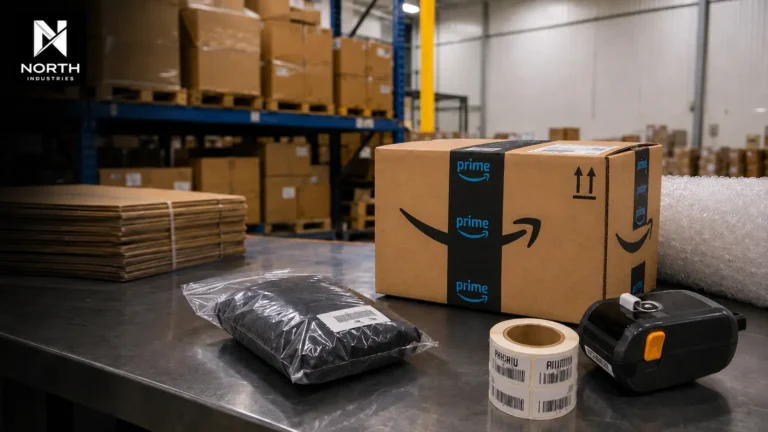
Amazon FBA prep in Mississauga is how GTA sellers get imported or manufactured inventory labelled, packaged, and delivered to Amazon’s fulfilment centres without handling the compliance work themselves. If you are a private label seller bringing a container in from overseas, or a marketplace seller who just got hit with a removal order, this guide covers what prep now requires in 2026, what it costs, and how to choose a prep partner close to Amazon’s GTA facilities.
TL;DR
- Amazon FBA prep is getting your inventory receiving-ready to Amazon’s exact standards (FNSKU labelling, poly bagging, bundling, carton labels) before it enters a fulfilment centre.
- This changed in 2026: Amazon ended its own in-house prep and labelling service on January 1, 2026, so every unit must now arrive fully prepped, or the shipment gets rejected or hit with fees.
- A Mississauga prep centre sits in the same industrial corridor as Amazon’s Brampton and Caledon fulfilment centres, which shortens the inbound leg and the customs path for importers.
- Prep is priced per unit. Market rates for standard items start around $0.40 and rise with add-ons like bundling and bubble wrapping; oversized items cost more.
- Doing container receiving and FBA prep under one roof removes a freight leg and a second vendor for importers bringing goods in from overseas.
What does Amazon FBA prep involve?
Amazon FBA prep is the set of steps that make each unit compliant with Amazon’s receiving rules before it reaches a fulfilment centre. At minimum, every unit needs a scannable FNSKU barcode, protective packaging suited to the product, and correct carton and pallet labelling. Get any of it wrong, and Amazon can refuse the shipment at the door.
The core prep tasks are consistent across most products:
- FNSKU labelling: applying Amazon’s unique barcode to each unit so it maps to your listing
- Poly bagging: sealing units, with suffocation warnings on bags over a certain size
- Bundling and kitting: assembling multipacks and sets, marked “sold as set” where required
- Bubble wrapping: protecting fragile items from transit damage
- Carton and pallet prep: labelling boxes, building pallets, and creating the shipment plan in Seller Central
Some categories carry extra rules. Consumable and perishable products must show expiration dates in a set format, and certain items need specific packaging. A prep centre that knows Amazon Canada’s requirements handles these details so your inventory does not get flagged.
What changed in Amazon’s 2026 prep requirements?
The biggest change is who does the prep. Amazon discontinued its own FBA prep and item-labelling service on January 1, 2026, which means units can no longer be sent in unprepped for Amazon to label. Every unit must now arrive fully prepped and compliant, so sellers either do it themselves or use a third-party prep centre.
Alongside that, Amazon adjusted its inbound fees on January 15, 2026. The inbound placement service fee, introduced in March 2024, still charges you for sending inventory to fewer receiving locations, and it moved to new weight bands for standard items. A consolidated inbound defect fee, averaging around $0.60 per unit and reported to range roughly $0.32 to $1.74 for standard units, now applies to shipments that are mislabelled, misrouted, or arrive late. Base fulfilment fees also rose about $0.08 per unit on average.
Two practical takeaways follow from this. First, prep accuracy now carries a direct financial penalty, so the margin for error is smaller. Second, how your inventory is split and routed to fulfilment centres affects your placement fee, which is where a prep partner with direct routes to multiple GTA facilities earns its keep.
Can you receive your container and prep for FBA in one place?
Yes, and for importers this is the setup that removes the most cost and risk. When your goods arrive by ocean container, the container has to be unloaded, the inventory counted and inspected, then prepped for Amazon. Doing all of that in one facility means the product is received, prepped, and dispatched to Amazon without a freight leg to a second location or a handoff between two vendors.
North Industries receives containers and preps for FBA at the same Mississauga facility, so an importer’s goods move from the container to Amazon-ready in one place. If you want the receiving side in more depth, we cover what happens when your container arrives separately. The alternative, unloading at one warehouse and trucking to a prep centre elsewhere, adds handling, time, and cost that most sellers do not budget for.
What should you do with an Amazon removal order?
An Amazon removal order is Amazon returning your inventory to an address you nominate, either because units are unfulfillable, aged out, or you requested them back. The inventory often comes back mixed, unlabelled, or in damaged packaging, which makes it hard to resell as is. A prep centre can receive the removal order, sort and inspect the units, and salvage what is sellable.
From there, salvaged inventory usually takes one of two paths. Clean, relabelled units can be re-prepped and sent back into FBA under fresh FNSKU labels, or they can be redirected to another channel such as your own store, a marketplace, or B2B. Having a receiving partner in the GTA means removal orders land close to where they can be assessed and turned around, rather than piling up in a space you have to manage yourself.
How much does Amazon FBA prep cost in Canada?
Amazon FBA prep in Canada is priced per unit, with a base fee that usually covers receiving, FNSKU labelling, and basic packaging, and add-ons priced separately. Published market rates for standard-size items start around $0.40 per unit, and some Canadian centres price individual tasks lower, for example, inspection with labelling near $0.17 per item, with poly bags and bubble bags added on top. Oversized and bulky items cost more because they take more handling.
The table below shows the kinds of line items that make up a prep quote. Read it as the shape of the pricing, not a rate card, since real cost depends on your product, volume, and packaging.
Prep line item | How it is usually charged |
Receiving and inspection | Per unit or per carton |
FNSKU labelling | Per unit or per label |
Poly bagging/bubble wrapping | Per bag, by size |
Bundling and kitting | Per unit or per set |
Carton labelling and palletising | Per carton or per pallet |
Freight to the fulfilment centre | By distance and shipment size |
North Industries quotes FBA prep on a per-unit basis for labelling and packaging plus per-order handling, or as a per-project quote for larger runs, and reviews smaller volumes rather than turning them away. Because true cost depends on your SKU count and prep complexity, the practical step is a quote against your actual inventory.
How do you choose an FBA prep centre in Ontario?
Choosing an FBA prep centre in Ontario comes down to Amazon expertise, location, and how they price. A centre that does not know Amazon’s current requirements will cost you far more in rejected shipments and defect fees than any per-unit saving. Proximity to Amazon’s GTA fulfilment centres also matters, because a shorter inbound leg means lower freight and faster check-in.
Questions worth asking before you commit:
- Do you know Amazon Canada’s current prep and labelling requirements?
- How close are you to the Brampton and Caledon fulfilment centres?
- How do you price: per unit, per label, add-ons, and freight?
- Can you also receive my container and store inventory, or only prep?
- What is your turnaround from receiving to dispatch?
- How do you handle removal orders and returns?
That fourth question is where an integrated operator separates from a prep-only shop, which is what the next section covers.
How North Industries handles Amazon FBA prep in Mississauga
North Industries handles Amazon FBA prep at its facility at 3186A Lenworth Drive in Mississauga, in the same industrial corridor as Amazon’s fulfilment centres in Brampton and Caledon. Inventory can be received, inspected, FNSKU-labelled, packaged, and palletised in one place, then delivered to the fulfilment centres on North’s own vehicles rather than handed to a third-party carrier.
For importers, the advantage is the full path under one roof: North unloads the container, preps the units, and forwards them to Amazon, so goods move from port to Amazon-ready without a detour. You can see the broader logistics side on the third-party logistics and fulfilment page, and the dedicated Amazon FBA prep service covers the prep offer in detail. For sellers who also warehouse in the GTA, our guide to 3PL in Mississauga explains how prep and storage fit together.
Frequently asked questions
- What is FNSKU labelling and do I need it?
FNSKU labelling means applying Amazon’s unique barcode, the Fulfilment Network Stock Keeping Unit, to each unit so Amazon can track it to your specific listing. Yes, you need it for FBA. Without a scannable FNSKU, Amazon cannot receive your units correctly, which leads to delays, commingling issues, or a rejected shipment. - Can a Canadian prep centre ship directly to Amazon US?
Yes, a Canadian prep centre can prep and forward inventory to Amazon US fulfilment centres, but the shipment crosses the border, so customs clearance, an importer of record, and duties apply. Confirm who handles the customs side before you ship, since that responsibility varies by prep centre and by how your account is set up. - How long does FBA prep take?
Turnaround depends on the centre and your volume. Many prep centres process inventory within one to two business days of receiving it, then dispatch to the fulfilment centre. Ask for the turnaround window upfront, because slow prep eats into the delivery-time promise that keeps your listings healthy. - What happens if Amazon rejects my shipment?
Amazon can reject or penalise shipments that arrive mislabelled, poorly packaged, or misrouted, and in 2026 those errors can trigger inbound defect fees. Rejected inventory may be returned or held, which stalls your sales. This is the main reason sellers use a prep centre that knows Amazon’s requirements rather than risk the penalty. - Do I need a prep centre if I already have a 3PL?
Not always, because some 3PLs include FBA prep as a service. The question to ask your 3PL is whether they prep to Amazon’s current standards and deliver to the fulfilment centres. An operator that does both prep and 3PL under one roof lets you avoid splitting the work across two providers. - What is the difference between FBA and FBM?
With Fulfilment by Amazon (FBA), Amazon stores and ships your inventory. With Fulfilment by Merchant (FBM), you or your 3PL store and ship orders yourself. Many sellers run both.
Ready to prep and ship your Amazon inventory?
If you are importing a container or scaling an Amazon listing, North Industries can receive, prep, and deliver your inventory to Amazon’s GTA fulfilment centres from one Mississauga facility. Get an FBA prep quote with your product, monthly volume, and prep needs, or book a tour to see the operation before you commit.