
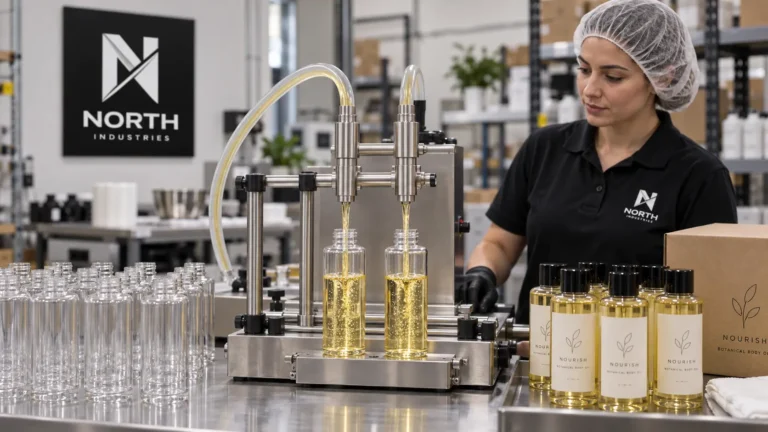
If you have a formulation you have been mixing by hand and orders are climbing past what you can pour yourself, working with a liquid filling company in Ontario is how you hand production over to a professional and get your time back for marketing and brand building. Liquid filling is the step that turns your formula into a filled, capped, labelled, shelf-ready product. This guide explains what liquid filling involves, which fill method suits your product, how it is priced, what minimum runs to expect, how quality is controlled, and how filling and fulfillment fit together.
The short version
- Liquid filling is the production step that turns your finished formulation into filled, capped, labelled, sellable units, so you don’t buy filling equipment or run a line yourself.
- The right fill method depends on how thick your product is. Thin liquids suit gravity and overflow fillers, while creams, gels, and thick products need piston or pump fillers.
- A liquid filling company in Ontario can handle beauty oils and serums, household cleaners, automotive liquids, personal care, and pet products, among other non-food consumer liquids.
- Minimum runs are the biggest hurdle for small brands, but flexible fillers take small-batch and pilot runs, so your volume may already justify professional filling.
- Filling with the same partner that labels, stores, and ships your product removes the freight and coordination of running two separate vendors.
What does liquid filling involve?
Liquid filling is the process of transferring your finished product into its final container, then capping, labelling, and preparing it for sale. A run usually moves through four stages: batching or receiving your bulk product, filling it into bottles or jars at measured volumes, capping and sealing, and applying labels before the finished units are cased and palletised.
You supply the formulation, or have it made, and the filler handles the mechanical work of getting it into containers accurately and consistently. For a liquid product, filling is the core of a broader service that often extends into co-packing and retail-ready packaging, such as multipacks, inserts, and display packs, once the units are filled and labelled.
What are the main types of liquid filling, and which is right for your product?
The right fill method is decided by your product’s viscosity, meaning how thick or thin it is. Thin, free-flowing liquids fill cleanly on gravity and overflow machines, while thick creams, gels, and products with particles need the extra push of a piston or pump filler. Matching the method to the product is what keeps fills accurate and consistent.
Here is how the four common methods line up against product type.
Fill method | Best suited to | Typical products |
Gravity | Thin, free-flowing liquids | Light oils, toners, thin cleaners |
Overflow | Thin to medium liquids, and foamy products | Serums, micellar waters, clear cleaners in see-through bottles |
Piston | Thick, viscous products and those with particles | Creams, balms, gels, textured products |
Pump | A wide range, thin to highly viscous | Cosmetics, household and automotive liquids |
Overflow filling earns its place with clear bottles, because it fills every container to the same visible level for a consistent look on the shelf. Piston and pump fillers handle thickness that would clog or slow a gravity line. A good filler matches the equipment to your product rather than forcing every job through one machine.
Which products are suited to liquid filling?
Most non-food consumer and industrial liquids can be professionally filled, across beauty, personal care, household, automotive, and pet categories. If your product pours, sprays, or dispenses, there is almost certainly a fill method that fits it. Naming your category early helps a filler scope the run and quote accurately.
The categories North Industries fills, with the kind of products in each, include:
- Beauty and wellness: face oils, serums, toners, and other light liquids for growing skincare brands.
- Personal care: shampoos, conditioners, lotions, and washes.
- Household and cleaning: sprays, concentrates, and surface cleaners, the core of household liquid co-packing in Canada.
- Automotive: waxes, wash concentrates, and detailing liquids.
- Pet care: shampoos, sprays, and grooming liquids.
You can see the consumer categories North works with in one place. The value of naming your product type is speed: a beauty founder filling a face oil and an automotive brand filling a wash concentrate need different handling, and a filler that already works across these categories can tell you quickly whether you fit.
How is liquid filling priced in Canada?
Liquid filling in Canada is usually priced in three parts: a setup or changeover fee for each run, a per-unit fill rate, and the cost of components such as bottles, caps, and labels. The setup fee is fixed per run, so it adds a lot per unit on a short run and very little on a long one, which is why volume changes the maths so much.
That single mechanic, a fixed setup cost spread across the units in the run, is the reason published per-unit rates online mean little for your specific job. Your real cost depends on your product, container, run size, and finishing. Rather than repeat the full breakdown here, the companion guide to how contract bottling is priced and what to expect works through the cost mechanics in detail. North Industries quotes filling on a per-bottle or per-filled-unit basis, or as a per-project quote, against your actual product and volume.
What is the minimum batch size for liquid filling, and can you negotiate it?
Minimum batch size, or MOQ, is the smallest run a filler will accept, set to cover the fixed cost of setting up and cleaning down a line. Minimums vary widely, and this is the single biggest reason early-stage brands struggle to find a partner. It is often negotiable, and some fillers take small-batch and pilot runs.
The pressure is real: as large contract manufacturers chase bigger clients, they leave room for smaller operators to take on early-stage brands with lower minimums, some in the range of a few hundred units. You can improve your position by showing genuine growth intent, being flexible on scheduling, and accepting a higher per-unit cost on a short first run. North Industries supports small-batch production, trial runs, and pilot runs, so an early-stage brand can start with a smaller, discussed batch rather than being turned away for missing a large national minimum. Exact minimums depend on your product and container and are set at quote.
How is quality controlled during liquid filling?
Quality control during liquid filling is what keeps your product consistent from batch to batch and protects it from contamination. The core controls are cleaning and resetting the line between products, batch-coding each run for traceability, checking fill volumes, and running a trial batch before full production so the fill is dialled in.
For the two fears most founders carry, here is how filling addresses them. Consistency comes from measured, volumetric fills and a signed-off trial run, so the hundredth bottle matches the first, and from batch coding that makes any run traceable. Contamination is managed by cleaning and changing over the line between different products, following client-specific handling instructions, and keeping each client’s inventory separated. Reputable fillers also sign a non-disclosure agreement before you share your formula, so ask for one early. North Industries follows documented handling instructions, quality checks, and a test run before full fulfillment for exactly these reasons.
Why combine liquid filling and 3PL at one facility?
Combining filling with warehousing and fulfillment at one facility removes the double freight and two-vendor coordination that most brands pay for without noticing. When your product is filled, then trucked to a separate warehouse, you pay for the move, manage two relationships, and carry the risk in the handoff. Filling and shipping from one building removes all three.
At an integrated operation, finished units move straight off the filling line into storage and out to customers without leaving the building or changing hands. That matters most for a small team, because one relationship covers filling, labelling, storage, order fulfillment, and delivery instead of four. It is the difference between managing a supply chain and handing it to a single accountable partner.
How does North Industries handle liquid filling in Ontario?
North Industries is a liquid filling company in Mississauga, Ontario, that fills non-food consumer and industrial liquids across beauty, personal care, household, automotive, and pet categories. Filling is a core service, offered as flexible small-batch and semi-automated production for growing brands, and priced per unit or by project quote.
The practical advantage is that filling does not happen in isolation. Finished units can move from the line straight into warehousing and out on North’s own delivery vehicles across the GTA, so one relationship spans the full range of what North fills, packs, and builds through to storing and shipping every order. You deal with the people running the floor, not a call centre, and for regulated categories such as food, beverages, or supplements, North will tell you plainly what it can and cannot take on. The company operates from 3186A Lenworth Drive in Mississauga.
Frequently asked questions
- What types of liquids can be contract filled?
Most liquids can be contract filled, from thin, free-flowing products like light oils, toners, and cleaners, to medium liquids like lotions, to thick creams, gels, and pastes. Many fillers also handle sprays and light powders. The product’s thickness decides the fill method, so describe your product’s consistency when you enquire. - What certifications should a liquid filling company have?
It depends entirely on your product category. Cosmetics require Health Canada cosmetic notification, natural health products need a Site Licence, an NPN, and Good Manufacturing Practices, food and beverages need a CFIA licence and often HACCP or SQF, and consumer chemicals carry SDS and WHMIS obligations. Confirm what your category requires with any filler, in writing. - Can a liquid filling company also label and warehouse my product?
Many can, and choosing one that does saves you a freight leg and a second vendor. An integrated filler applies your labels as part of the run, then stores the finished inventory and ships orders from the same facility. North Industries fills, labels, warehouses, and delivers from one Mississauga operation. - How long does liquid filling take from start to finished product?
Timing depends on your components, run size, and the filler’s schedule. Once your artwork is approved and your bottles, caps, and labels are on hand, a straightforward run is often completed within days of its scheduled slot. Sourcing custom components is usually the longest part, so confirm lead times before you commit.
Ready to fill your product?
If you have a formulation and you are ready to move from hand-filling to professional production, request a liquid filling quote with your product, container, and target run size, or book a tour of the Mississauga facility to see the operation before you commit.