
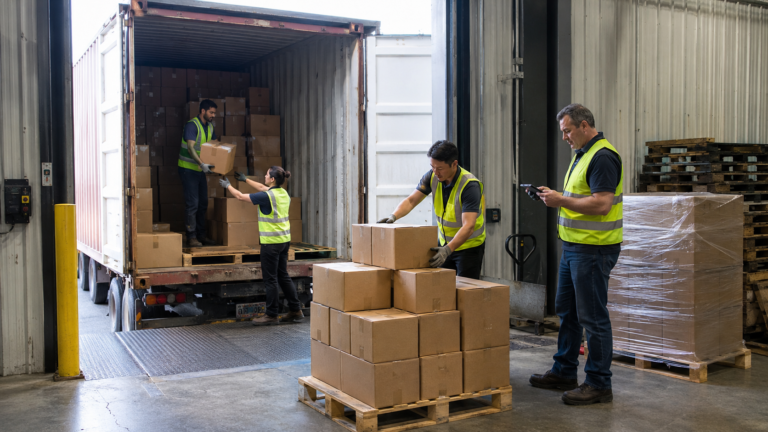
If you are a first-time importer and your container is arriving in Mississauga or has already arrived, here is what needs to happen, in order, so you can act today without guessing. Container unloading is only one step in a short sequence, and the fees that catch people out come from moving too slowly through it, not from the unloading itself.
TL;DR
- Your container can’t reach a warehouse until customs releases it. Under CARM, you need your own CBSA portal account to clear, whether you self-clear or use a broker.
- Getting the box from the rail terminal to the warehouse is called drayage, roughly $250 to $600 for a 40-foot container in the GTA.
- Two clocks cause surprise charges: demurrage while the box sits at the terminal, detention once you hold the empty too long after pickup. Fast unloading beats both.
- A crew unloads most 40-foot containers in a few hours. Floor-loaded loose cargo takes longer than palletized freight.
- The number that matters is the count. Check what comes off the truck against your packing list on receipt, before anything moves into storage.
The next 48 hours, in order: confirm your container is customs-released, arrange drayage from the terminal to your warehouse, book the warehouse to receive and unload it, then verify the count as it comes off. The rest of this guide walks through each step.
What has to happen before your container can be delivered to a warehouse?
Your container has to clear customs before it can move to a warehouse. Until the Canada Border Services Agency (CBSA) releases the shipment, the box stays at the terminal, and no one can truck it to you. So the first call is not the warehouse. It is making sure your customs clearance is handled.
Since 2024, clearance runs through CARM, the CBSA Assessment and Revenue Management system. Every commercial importer now needs its own CARM Client Portal account, a Business Number with an import-export (RM) account, and its own financial security posted with CBSA. As of January 1, 2026, a customs broker can no longer use their own business number to clear goods on your behalf.
North Industries is not a customs broker and does not clear shipments. The warehouse receives your goods after CBSA releases them. This section is general information, not customs or legal advice, so confirm your own setup with a licensed broker or CBSA directly.
What is drayage and how do you arrange it in the GTA?
Drayage is the short truck move that takes your container from the terminal to your warehouse. It is a specialized service because the carrier needs terminal access, a chassis to carry the box, and the right paperwork to release it, which is why it is arranged separately from ordinary trucking.
One thing surprises most first-time importers: your ocean container does not arrive at a Toronto seaport. The Port of Toronto is a bulk cargo port for goods like sugar, salt, and cement, not a container gateway. Containers from Asia land at Vancouver, Prince Rupert, or Montreal, then travel by rail to one of the two GTA inland terminals, CN’s Brampton Intermodal Terminal or CPKC’s Vaughan Intermodal Terminal. Your drayage runs from that rail terminal to your dock.
In the GTA (Greater Toronto Area), drayage for a 40-foot container generally runs about $250 to $600 per move, plus a fuel surcharge and, in some cases, a chassis or terminal-congestion fee. You can book a drayage carrier yourself, or have your warehouse coordinate it. North Industries coordinates inbound drayage through approved carriers and receives the container at its Lenworth Drive dock, so you deal with one team from the terminal to the shelf rather than lining up trucking and receiving separately.
How do you avoid demurrage and detention charges?
You avoid them by moving the container out and the empty back within the free time the carrier allows, usually a couple of business days. The charges people fear are two different clocks, and understanding which is which is how you keep them at zero.
- Demurrage is charged when your loaded container sits at the terminal past its free time, because it was not picked up fast enough.
- Detention, sometimes called per diem, is charged after pickup, when you keep the carrier’s container too long before returning it empty, usually because unloading was slow.
The simple way to remember it: demurrage means the box is stuck at the terminal; detention means the box is stuck with you.
Both clocks reward the same thing: speed and coordination. If clearance is ready, drayage is booked, and the warehouse is scheduled to receive the container the day it arrives, the box gets picked up inside the free window, unloaded quickly, and returned empty before detention starts. Most surprise charges come from a warehouse that could not take the container on time, which is why booking your receiving slot early matters as much as the drayage itself.
What happens when your container is unloaded at the warehouse?
At the warehouse, the container is unloaded, its contents are checked, and the goods are moved inside for staging or storage. This step is called devanning, and how long it takes depends almost entirely on how the container was packed.
A crew unloads most 20- or 40-foot containers in a few hours. Palletized freight comes off fast, because a forklift can move whole pallets straight to the dock. Floor-loaded cargo, meaning goods stacked loose inside the container without pallets, takes longer because each carton is handled by hand before it can be organized. Knowing which one you have tells you roughly how long the box will be at the dock, and that feeds directly back into the detention clock from the last section.
How does loose cargo get palletized for storage?
Palletization is the step that turns loose, floor-loaded goods into organized, wrapped pallets ready for storage or shipping. As cartons come off the container, the crew stacks them onto pallets by product, secures them with stretch wrap, and labels them so each pallet can be tracked.
This step does more than tidy the goods. A floor-loaded container is just a wall of boxes until it is palletized, and nothing downstream- not storage, not picking, not shipping- can happen cleanly until the inventory is on pallets and organized. Getting it right on receipt is what keeps the goods protected and findable later.
How is your inventory counted and recorded when it comes off the container?
Your inventory is counted against your packing list or bill of lading as it is unloaded, and the recorded count becomes the reference point for everything that follows. This is the step that answers the fear behind most container searches: whether what you paid for is actually what arrived.
A careful receiving process checks quantities and condition at the dock, not later. The crew counts units as they come off, compares them to your documents, and flags any shortage, overage, or damage on receipt, while the container is still there and the evidence is clear. That recorded, reconciled count is what your storage, fulfillment, or claim against a supplier all rest on, so it is worth confirming the receiving team does this as standard rather than assuming it.
What happens to your inventory after it’s unloaded?
Once your goods are received and organized, they move into one of three paths depending on what you are doing with them:
- Storage: the pallets go into warehouse space until you need them, billed by the space or pallet positions they use.
- Fulfillment: the inventory feeds an order operation, where a team picks, packs, and ships orders as they come in. North Industries 3PL fulfillment service and its 3PL and warehousing in Mississauga cover how that works.
- Amazon FBA prep: if the goods are headed to Amazon, they are labelled and packed to FBA’s requirements before being forwarded, which we cover in our guide to preparing inventory for Amazon FBA.
Most first containers go to storage or fulfillment. The point is that the receiving step sets all three up, which is why getting the count and the palletization right at the dock matters more than it seems in the moment.
How does North Industries handle container receiving at Lenworth Drive?
North Industries gives importers one location to receive, unload, palletize, organize, and count an incoming container, without hiring separate labour or equipment for each step. The drayage is coordinated through approved carriers, the container is received and devanned at the Lenworth Drive dock, loose cargo is palletized and wrapped, and the count is reconciled against your documents on receipt. For a first-time importer, that means one accountable team from the terminal to the shelf instead of juggling a trucker, a labour crew, and a storage provider separately.
The facility is at 3186 Lenworth Drive, Mississauga, ON L4X 2G1, in the Dixie industrial area with quick access to Highway 427, an interchange with Highway 401 nearby, and Toronto Pearson just to the north. That keeps the drayage leg from the GTA rail terminals short. If your container is arriving soon and you want it received cleanly, you can book container receiving and have the slot ready before the box lands.
Frequently asked questions
- How much does container unloading cost in Canada?
Container unloading, or devanning, is usually priced per container or by the labour and time involved, and varies with whether the cargo is palletized or floor-loaded. Floor-loaded containers cost more because each carton is handled by hand. Most warehouses quote it alongside receiving, so ask for unloading and receiving together when you request a quote. - How long does it take to unload a container at a warehouse?
A professional crew unloads most 20- or 40-foot containers in a few hours. Palletized freight comes off quickly because forklifts move whole pallets at once. Floor-loaded cargo, stacked loose without pallets, takes longer because every carton is handled individually and then palletized. The packing method is the main factor in the time. - Do I need a customs broker before delivering to a warehouse?
You do not legally need a broker, but your container must be customs-released before it can go to a warehouse, and under CARM you need your own CBSA portal account either way. You can self-clear, use the carrier’s brokerage, or hire a licensed broker. The warehouse receives the goods after CBSA releases them; it does not clear customs for you. - Can a 3PL receive my container directly?
Yes. A 3PL can receive your container once it has cleared customs, and many coordinate the drayage from the rail terminal too, so the same team handles the move, the unloading, and the count. You provide your packing list and shipment documents so the receiving crew can reconcile the count against them as the container is unloaded. - What is a devanning fee?
A devanning fee is the charge for unloading a shipping container, the labour and equipment to take goods out and move them into the warehouse. Devanning is simply the industry term for container unloading. The fee depends on container size and whether the cargo is palletized or floor-loaded, since loose cargo takes more time and handling.
Book container receiving at Lenworth Drive
If your container is on its way, the cleanest way through the next 48 hours is to have clearance sorted, drayage arranged, and your receiving slot booked before it arrives. North Industries can coordinate the move and receive, unload, palletize, and count your container at its Mississauga facility, so it lands with one accountable team. Book container receiving, and we will have the slot ready.