
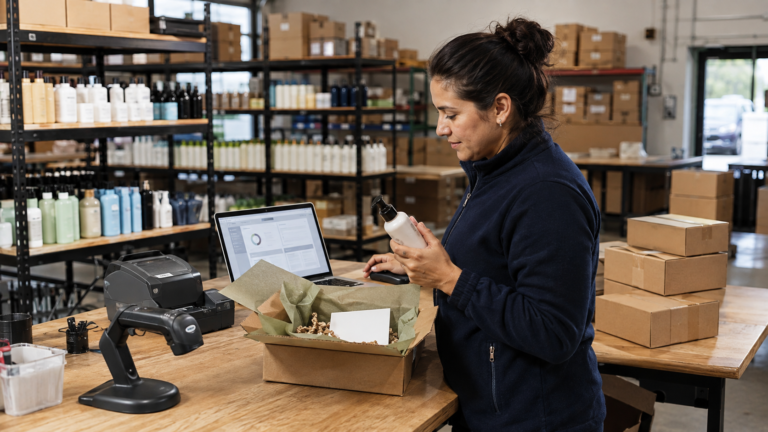
Shopify fulfillment in Canada used to have an obvious default: Shopify’s own network. That has changed. Shopify sold its fulfillment business to Flexport in 2023 and no longer runs fulfillment itself; starting January 2026, Flexport charges a $5,000 monthly minimum that prices out most brands shipping a few hundred orders a month. So if you are a Shopify brand outgrowing your own packing table, the question is no longer whether to outsource. It is how to hand fulfillment to a Canadian 3PL without losing control of your inventory, your sync, or your customer experience.
TL;DR
- Shopify no longer runs its own fulfillment. Its network is operated by Flexport, whose minimum rises to $5,000 a month in 2026, pushing smaller brands toward independent 3PLs.
- Outsourcing does not have to mean losing control. The three risks that actually matter are inventory sync, packing quality, and returns, and each one is manageable.
- Overselling usually comes from selling the same stock across Shopify, Amazon, and wholesale without one connected inventory picture, not from a single-store glitch.
- Your branded unboxing survives outsourcing when the 3PL follows your packing spec and inserts your own materials.
- Before you hand over your store, ask about access, sync, multi-channel handling, returns, and reporting.
Does Shopify handle fulfillment, or do you need a 3PL?
Shopify does not handle fulfillment for you anymore. It sold its logistics arm, including the Shopify Fulfillment Network, to Flexport in 2023 and stepped back to focus on software. To outsource order fulfillment as a Shopify brand today, you work with a third-party logistics provider (3PL), a company that stores your inventory and picks, packs, and ships your orders.
The reason this matters right now is cost. Flexport, which runs the old Shopify network, is raising its minimum monthly fulfillment fee from $500 to $5,000 starting January 1, 2026, and bills merchants the difference if they do not reach it. For a brand doing 150 to 300 orders a month, that minimum is far more than the fulfillment is worth, which is why industry coverage describes the change as pushing small and mid-size merchants toward independent 3PLs with clearer pricing. The practical takeaway: the default option quietly stopped fitting growing Canadian brands, so it is worth choosing a partner deliberately rather than defaulting.
How do you know it’s time to outsource Shopify fulfillment?
You are ready to outsource when fulfillment starts costing you the time and space your business needs to grow. There is no exact order count, but the signs are consistent, and most founders hit them somewhere between a couple hundred and a thousand orders a month.
- Shipping is eating your week. The hours going into picking, packing, and post office runs are hours not going into product, marketing, or customers.
- You have run out of room. Inventory has taken over the garage, the spare room, or a unit you are now paying for anyway.
- Errors climb with volume. As orders rise, wrong items and missed shipments creep in, and every mistake costs a refund and a customer’s trust.
If one of these is true occasionally, you can probably keep going. If two or three are true every week, the math has already tipped toward outsourcing.
How does Shopify 3PL fulfillment actually work?
Shopify 3PL fulfillment connects your store to a warehouse so orders are shipped without you touching them. When a customer orders, the order passes from Shopify into the 3PL’s inventory and order system; the warehouse team picks and packs it, and the shipment goes out with tracking and inventory updating back against your store. You keep the storefront and the brand; the 3PL runs the physical work behind it.
Connecting a store to a 3PL is not one single thing, and the method matters. Some providers use a direct connection to Shopify, others route through a connected inventory system that syncs with your store, and the weakest rely on scheduled file transfers that update only every few hours. The difference shows up as latency, meaning how quickly a sale on Shopify becomes a reduced count in the warehouse and how quickly tracking flows back to your customer. When you evaluate a partner, ask how orders and inventory move between Shopify and their system, and how often, because that answer predicts most of the problems you will or will not have.
What happens if your Shopify and 3PL inventory don’t sync?
If your Shopify and 3PL inventory fall out of sync, you oversell, meaning you sell stock you no longer have and then cancel on the customer. It is the single most feared outsourcing failure, and it is worth understanding where it actually comes from, because the common assumption is wrong.
Most overselling is not a single-store glitch. It happens when the same units are sold across more than one channel at once- Shopify plus Amazon plus a wholesale order- and no single system holds the true count. One channel sells the last case while another still shows it available. The defence is not a flashier logo; it is one connected inventory picture across every channel, with the counts reconciled and a sensible buffer on low-stock items. This is exactly why multi-channel handling, covered further below, matters more than any single integration claim. When you assess a 3PL, the real question is not “do you sync with Shopify,” it is “how do you keep one accurate count when I am selling the same product in three places.”
Will your customers still get a branded unboxing, or a generic box?
Yes, your unboxing stays yours, as long as your 3PL follows your packing specification. A good fulfillment partner packs to your instructions, inserts your branded materials, tissue, cards, or inserts, adds your packing slip, and ships retail-ready, so the box that arrives looks like your brand and not a generic warehouse parcel.
This is a real question to ask, not an assumption to make, because packing quality varies widely between providers. North Industries handles custom packaging insertion, packing-slip insertion, and retail-ready packaging as part of its fulfillment work, which means the customer experience you built does not get flattened the moment someone else packs the box. If branded presentation is central to your product, put your packing spec in front of any prospective partner and confirm they will follow it before you commit.
What should you ask for a 3PL before giving it access to your Shopify store?
Before you grant a 3PL access to your store, get clear answers on five things, because they decide whether the handoff protects your control or quietly erodes it. Handing over store access is a real step, so treat these as non-negotiable questions rather than nice-to-haves.
- Access and permissions: what level of Shopify access they need, and what they will and will not touch.
- Sync method and speed: how orders and inventory move between Shopify and their system, and how quickly.
- Multi-channel handling: whether they can keep one inventory count across Shopify, Amazon, and any wholesale or retail channels you sell through.
- Returns: how returned orders are received, inspected, and put back into sellable stock.
- Reporting and contact: what visibility you get into inventory and orders, and who you actually reach when something goes wrong.
The last point is where providers diverge most. Some route you through a ticket queue and offshore email; others give you a named contact who knows your account. That difference is invisible on a sales page and obvious the first time an order goes sideways.
Will a 3PL handle your Shopify returns?
Yes, a capable 3PL manages returns as part of fulfillment, not as an afterthought. Returned orders come back to the warehouse, where they are received, inspected, and either restocked as sellable inventory or set aside if they cannot be resold, so your available count stays accurate and good stock goes back to work quickly.
Returns are part of keeping control, not a separate problem. North Industries handles returns receiving, inspection, restocking, and repackaging, which closes the loop on the same inventory picture that prevents overselling. When you evaluate a partner, ask how a return moves from the customer’s hands back into your sellable stock, and how long that takes, because a slow or vague returns path ties up both inventory and cash.
Which Shopify fulfillment SLAs actually matter?
For a Shopify brand, the service standards that matter are the ones your customer feels: how fast tracking is handed back to the order, how reliably inventory stays in sync, and whether same-day orders actually go out the same day. A service-level agreement (SLA) is simply the standard a provider commits to for those things.
Tracking speed is the one brand underrated. Email and SMS tools that notify your customer rely on the 3PL pushing tracking back to the Shopify order within minutes of the label being created, not hours, or the shipping notification lands late and support tickets follow. Ask a prospective partner how quickly tracking flows back, how they keep counts accurate, and what their same-day cut-off is. On the numbers themselves, be wary of any 3PL advertising a headline figure like “99.9% accuracy” without explaining how they measure it. North Industries does not publish blanket accuracy or on-time guarantees; its commitments are qualitative: careful handling, following your documented instructions, prompt escalation, and supporting a test order before full launch, with formal accuracy targets and cut-offs set per account once your volume is understood. That is the honest version of an SLA, and it is worth more than a number on a page you cannot verify.
How does North Industries connect with Shopify?
North Industries connects to Shopify and Shopify Plus through a connected inventory and order management system, so your orders flow from your store into the system North works in, inventory is kept in sync, and shipments go out with tracking returned to the order. There is no self-serve client portal to babysit. Instead, you get reporting and answers directly from an accountable team, which is the point of working with a hands-on operator rather than a queue.
The real edge for a growing brand is that North keeps one inventory picture across channels. If you sell on Shopify, on Amazon, and to wholesale accounts, those are managed together rather than as disconnected silos, which is what prevents the multi-channel overselling described earlier. North Industries’ order fulfillment and distribution service covers the full picking, packing, and shipping operation, and for brands sending stock to Amazon as well, its work on preparing inventory for Amazon FBA sits alongside DTC fulfillment under one relationship. If you want to see how this would map to your store, you can start a Shopify fulfillment review and walk through your channels, volume, and packing needs with the team directly.
Frequently asked questions
- Can a Canadian 3PL integrate with Shopify?
Yes. Canadian 3PLs connect to Shopify so orders flow automatically from your store to the warehouse, and inventory and tracking sync back. The connection method varies, from direct integrations to connected inventory systems, so ask each provider how orders and stock move between Shopify and their system and how quickly, since that determines day-to-day reliability. - What is the best 3PL for Shopify in Canada?
There is no single best 3PL; the right one depends on your order volume, whether you sell on more than one channel, and how much branded and returns handling you need. Choose based on how they keep inventory synced across your channels, how they handle your packing spec, and whether you get a real contact rather than a ticket queue. - How much does Shopify fulfillment cost in Canada?
Shopify fulfillment is usually priced from a few parts: storage, a pick-and-pack fee per order, receiving, and sometimes a monthly minimum. Watch the minimums, since Flexport’s jumps to $5,000 a month in 2026. North Industries prices each account based on its actual work rather than a fixed rate card, so the quote reflects your real volume and handling. - Can a 3PL fulfill Shopify and Amazon orders together?
Yes, and doing both from one partner is often the point. When Shopify and Amazon inventory are managed as one count rather than in separate systems, you avoid overselling the same stock across channels, and one team handles both DTC orders and Amazon prep. Confirm the provider keeps a single inventory picture across every channel you sell on.
Start a Shopify fulfillment review
If Shopify fulfillment is taking over your week and the platform’s own network no longer fits your size, the fix is a Canadian partner who keeps your inventory synced, your packing on-brand, and your returns handled, with a real person accountable for it. North Industries can review your store, channels, and volume and show you how it would work. Start a Shopify fulfillment review, and we will map it to your operation.