
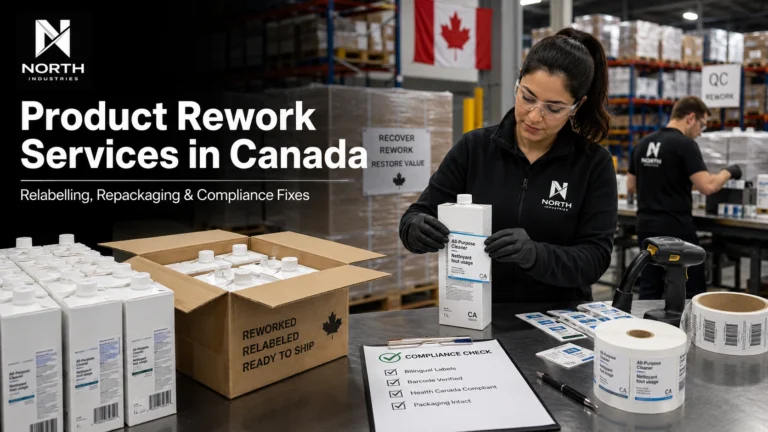
If your shipment has a labelling error, a retailer just rejected the pallet, or your imported inventory is stuck on a compliance problem, product rework is how you save the stock instead of writing it off. You do not have to ship it back to origin, and in most cases you do not have to lose the season. Here is what rework covers, what it costs, and how fast it moves.
TL;DR
- Most non-compliant or mislabelled inventory can be recovered. Rework corrects the problem in-country so the goods can ship, rather than forcing a return or a write-off.
- Cost is usually per unit, per hour, or a project rate. International benchmarks run from roughly CAD $0.50 a unit for simple relabelling upward, but the real number depends on your product, so it is quoted, not listed.
- Urgent jobs are measured in days, not weeks, once the corrected label or packaging spec is approved and materials are in hand.
- The most common triggers are barcode and label errors, retail compliance rejections, artwork or pricing updates, and rejected Amazon inventory.
- North Industries runs rework in Mississauga alongside warehousing, 3PL, and company-owned final-mile delivery, so reworked goods can go straight back out on North Industries own trucks in one relationship. Request a rework quote.
What is product rework?
Product rework is corrective work performed on finished goods to fix defects, labelling errors, packaging problems, or compliance gaps so the inventory can be sold or shipped. It covers relabelling, over-labelling, repackaging, barcode replacement, kitting corrections, and inspection. The goods are pulled from normal flow, corrected, documented, and returned to sellable condition, all without altering the product itself.
What are the most common product rework scenarios?
Most rework jobs trace back to a handful of predictable problems. The pattern is almost always the same: the product is fine, but something on or around it blocks the sale.
- Barcode and label errors: the wrong barcode, a non-scanning code, or a label with outdated pricing or SKU information.
- Retail compliance rejections: a big-box retailer refuses a pallet because case labelling, carton marks, or presentation do not meet its receiving spec.
- Artwork, pricing, or regulatory updates: existing stock carries a superseded label and needs an approved corrected version before release.
- Rejected Amazon inventory: units refused at an FBA fulfilment centre for FNSKU or packaging issues.
- Damage in transit: cartons arrive wet, crushed, or torn and need repackaging before they move on.
What is retail compliance rework?
Retail compliance rework is correcting inventory so it meets a specific retailer’s receiving standard, which is a common reason pallets get turned away at the dock. It can mean applying compliant case labels, adding carton or shipping marks, adjusting pack configurations, or fixing barcodes so they scan cleanly against the retailer’s system before the shipment is re-presented.
Can rejected or non-compliant Amazon inventory be reworked?
Yes. When Amazon refuses units for a barcode or packaging issue, FBA generally will not relabel them for you, so the practical path is to recall the inventory, correct it, and resend. A rework provider applies the correct FNSKU labels, fixes packaging to spec, and prepares the units to go back in. This is recovery of rejected stock, which is different from first-time Amazon FBA prep before your initial shipment.
Why do imported goods get rejected in Canada?
The single most common reason imported consumer goods are detained or rejected in Canada is labelling that is not bilingual. Under Canada’s Consumer Packaging and Labelling Act, mandatory information such as product identity and net quantity must appear in both English and French. A monolingual US label is one of the most frequent, and most avoidable, causes of a shipment being held at the border.
This is where rework earns its keep for brands entering Canada. Imported stock that arrives with a US-only label does not need to go back across the border. It needs over-labelling or relabelling with compliant bilingual information; a soap product, for example, declaring “Soap / Savon” with a bilingual net-quantity statement. Getting this wrong carries real exposure: some sources cite fines up to $20,000 for non-compliance with Canadian labelling rules. One important boundary: a rework provider executes the correction to an approved spec. It does not decide what your compliant label must say. The responsible brand or its regulatory adviser confirms the required content first. (This section is general information, not legal advice. Confirm your specific obligations with a qualified regulatory adviser.)
How much does product rework cost in Canada?
Product rework is priced one of three ways, depending on the job:
Pricing model | Best for | How it works |
Per unit | High-volume, repetitive tasks | A set rate for each unit reworked, e.g. relabelling a run of thousands |
Per hour | Mixed or complex jobs | Labour is billed by time when tasks vary unit to unit |
Project / flat rate | Defined, one-time projects | A single quoted price for the whole job, materials included |
North Industries prices rework the same three ways: by the unit, by the hour, or as a per-project quote, matched to the task. Per-unit fees suit repetitive work like relabelling a large run, hourly labour suits mixed jobs, and a project quote suits a defined one-time correction. There is no published rate card, because cost depends on unit complexity, whether new labels or packaging are sourced, volume, and turnaround pressure. As an international reference point only, simple relabelling has been cited around CAD $0.50 per unit, and UK reworkers near 60p per unit, with large projects running into the thousands over several days. Every job is quoted after North Industries reviews your product, unit count, and deadline.
How fast can product rework be done?
Urgent product rework is measured in days, not weeks, once two things are locked: the corrected label or packaging spec is approved, and the materials are on hand. Simple relabelling of a pallet or two can often move same-week; larger multi-thousand-unit projects scale with labour and material lead time. The delay is rarely the physical work. It is usually waiting on approved artwork or printed labels, so approving the corrected spec quickly is the fastest lever you control.
How is quality controlled during rework across thousands of units?
Quality control during rework depends on a documented, repeatable process rather than spot checks. Effective operations separate the rework area from regular flow, work to a written spec, verify corrected units, and reconcile counts before the batch is released back to inventory or shipment.
At North Industries, rework runs to the scope agreed for the job, with your inventory kept separated and organized rather than mixed with other accounts. Units pass through product inspection and quality-control checks, shipping labels and orders are verified against the spec, and inventory counts are reconciled before goods are released. On a large or unusual job, we can run a trial batch first, and any material change to scope is confirmed with you before the work continues. Every step is backed by traceable documentation, so you can see what was corrected and how many units passed.
Can relabelling be done at a 3PL warehouse?
Yes. Relabelling is a standard value-added service at a full-service 3PL, and having it done where your inventory already sits avoids a second freight move. The provider prints or applies new labels, over-labels non-compliant units, replaces non-scanning barcodes, and returns the stock to pick-ready condition, all inside the same facility that stores and ships it.
Do I need to bring my inventory to the warehouse for rework?
In most cases, the inventory is already there. If North Industries is warehousing your stock, rework happens in place, with no extra transport. If your goods are elsewhere, they are received into the Mississauga facility, reworked, and either stored, shipped, or sent back out, so you coordinate one location instead of moving product between a storage site and a separate reworker.
How North Industries handles product rework in Mississauga
North Industries runs product rework at its Mississauga facility as part of a single, vertically integrated operation, which is the practical difference for a brand in crisis. The stock does not travel between a warehouse and a standalone reworker and a separate carrier. It is received, corrected, quality-checked, and sent back out through 3PL fulfilment and North Industries own final-mile delivery, in one relationship.
Two things make this workable for time-pressured jobs. First, rework sits alongside North Industries broader capabilities, manufacturing, filling, co-packing, and warehousing, so materials and labour are on site rather than subcontracted out. If a job needs more than a label fix, the same team runs co-packing projects across Ontario, and the goods sit in the same facility covered in our guide to warehousing and 3PL in Mississauga. Second, we onboard projects below the pallet floors many national operators require, so smaller and urgent rework jobs that larger providers turn away can still get done. We have handled sizeable recovery work before, including a roughly 100-pallet product rework project and a napkin dispenser rework, for a major Canadian airline.
Frequently Asked Questions
- What is the difference between rework and repackaging?
Rework is the broad category of corrective work: relabelling, barcode fixes, inspection, compliance corrections, and repackaging. Repackaging is one type of rework, specifically moving goods into new or different packaging when the original format is damaged, obsolete, or unsuitable for the market. All repackaging is rework, but not all rework involves changing the packaging. - Is repackaging a product legal?
Generally, reselling genuine goods you have legally purchased is permitted, but repackaging raises trademark, labelling, and consumer-protection questions that depend on the product and your agreements with the manufacturer. Accurate labelling and clear disclosure matter. This is general information, not legal advice, so confirm your specific situation with a qualified adviser before proceeding. - Do you dispose of the old packaging and labels?
Yes, removed labels and old packaging are cleared as part of the job so the reworked units leave in clean, sellable condition. Disposal specifics are confirmed at quote. - Can rework fix non-scanning or wrong barcodes?
Yes. Replacing non-scanning or incorrect barcodes with correct, verified labels is one of the most common rework tasks, and units are scan-checked before release.
Ready to recover your inventory?
If you are facing a labelling error, a retail rejection, or a compliance hold, the faster you approve the corrected spec, the faster the stock ships. Request a rework quote or book a tour of the Mississauga facility through the contact page, and bring your product details, unit count, and deadline so the quote comes back accurate the first time.