
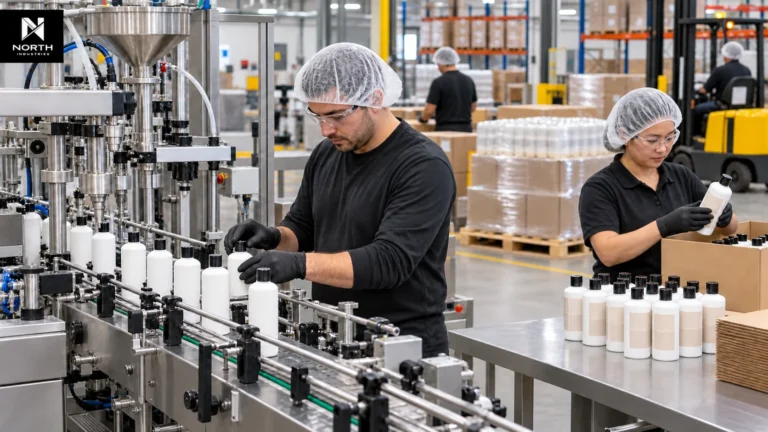
Founders of non-food consumer products can use contract manufacturing in Ontario to scale past small-space production without building a facility. Contract manufacturing works when three things are in place: a clear product specification, confirmed rules for your category, and approval control at each stage. For brands that outsource manufacturing in Canada, price comes after those three.
TL;DR
- Definition: A contract manufacturer makes your product to your specifications.
- Different models: Contract manufacturing differs from co-packing and private labels.
- Rules first: Your category’s federal rules apply before production.
- Formula protection: Sign agreements before you share your formula.
- One partner: Production through delivery with one partner removes handoffs.
What is contract manufacturing for consumer product brands?
Contract manufacturing in Ontario is an arrangement where a brand owns the product specification and brand name, and a manufacturer produces the product to that specification. For beauty, personal care, household, pet care, and automotive care brands, that partner is a consumer goods manufacturer in Ontario that makes, fills, and packs the product the brand designed.
Our production and packaging capabilities show which steps happen in-house.
How is contract manufacturing different from co-packing and private label?
Contract manufacturing, co-packing, and private label differ in who owns the product and how much of the work the manufacturer does. In consumer packaged goods (CPG) manufacturing in Ontario, the three terms are often mixed up on quotes and websites, so confirm which one a supplier means before you pay for it.
The table sets out who owns the product under each model.
Model | Who owns the product specification | What the manufacturer does |
Contract manufacturing | The brand | Produces the product to the brand’s specification, sold under the brand’s name |
Co-packing | The brand, which often supplies the product or its ingredients | Fills, packs, and labels the brand’s product into finished packaging |
Private label | The manufacturer, which offers a product it already makes | Supplies that product for the brand to sell under its own name |
If your product already exists and only needs filling and packing, read how co-packing works in Ontario.
Which regulations apply to your product before you outsource?
The regulations that apply before you outsource production depend on your product category. Cosmetics, consumer chemical products, and natural health products each fall under different federal rules. Each set affects which manufacturer can make or label your product and what must be filed or printed before the first sale.
What do cosmetic brands need to file with Health Canada?
Cosmetic brands must make sure Health Canada is notified within 10 days after a cosmetic is first sold in Canada. Under section 30 of the Cosmetic Regulations, the manufacturer or importer holds that duty. A third party can file for them but is not treated as the manufacturer unless it meets the regulation’s definition.
What labelling rules apply to household and automotive chemical products?
Household and automotive chemical products sold to consumers fall under the Consumer Chemicals and Containers Regulations, 2001 (CCCR, 2001). Health Canada’s CCCR guidance requires hazard symbols, warning statements, safety instructions, first aid statements, and disclosure of hazardous ingredients at 1% or more. Covered products include household cleaning products, adhesives, and lubricants.
Health Canada’s 2024-2025 compliance verification project evaluated 55 household chemical products, with these outcomes.
Outcome | Products |
Recalls | 7 |
Stop sales | 4 |
Stop distributions | 2 |
Commitments to fix non-compliance | 18 |
Several products failed irritant or corrosive labelling requirements, so check your labels before printing.
How do you protect your formula when you outsource manufacturing?
To protect your formula with a contract manufacturer, rely on contracts and careful disclosure, because Canada has no registration system for trade secrets. Sign a non-disclosure agreement before sharing anything, keep the full formula with your brand, and give the manufacturer only the specifications production needs to run your product.
The Canadian Intellectual Property Office (CIPO) says a trade secret can be a formula, recipe, process, or method whose value comes from staying secret. Canada has no federal trade secrets statute, so protection rests on common law claims such as breach of contract or confidence. Courts look at the steps a business took to keep information secret, so brands that outsource manufacturing in Canada should take these steps early:
- Sign first: a non-disclosure agreement before specifications change hands.
- Keep the master: the full formula stays with your brand.
- Share the minimum: only what production needs to make the product.
- Write ownership down: who owns the formula, specifications, and artwork.
This section is general information, not legal advice.
What should you look for in a contract manufacturer?
Look for a contract manufacturer that already makes your type of product, fits your category’s regulations, and puts its minimums, sampling process, and quality checks in writing. A good fit also opens its facility, explains its pricing, and plans for finished goods after production.
- Category experience: already makes products like yours.
- Regulatory fit: meets your category’s rules, verified by you.
- Minimum per SKU: the minimum run per stock-keeping unit (SKU), or product variant, in writing.
- Sample and trial runs: you approve before full production.
- Written quality checks: part of the agreed scope, not a verbal promise.
- Open facility visit: you see where your product will be made.
- Transparent pricing: every cost line explained up front.
- Finished goods plan: storage and shipping settled before production.
How much does contract manufacturing cost in Canada?
Contract manufacturing in Canada has no public national price benchmark, so each project is priced on its own. The price depends on how the product is made, how many units are run, and who supplies materials, so plan around a scoped quote built on your specification.
The main cost drivers are:
- Setup: preparing equipment for your product.
- Unit rates: a price per unit or per filled unit.
- Labour: hourly work such as assembly or quality control.
- Packaging materials: bottles, closures, labels and cartons.
- Minimums: where a process needs a minimum run to be practical.
North Industries’ starting prices for common production work are below.
Service | Starting price |
Production support | $75 per hour |
Labelling | $0.35 per unit |
Kitting | $2.00 per unit |
Contract packaging | $0.15 per unit |
Assembly | $75 per hour |
Quality control | $75 per hour |
Each figure is a starting point for a scoped quote. If the scope is still unclear, North Industries can begin with a discovery process, sample review or trial run before pricing production.
What documents do you need before contacting a contract manufacturer?
Before contacting a contract manufacturer, prepare a short written brief covering the product, its packaging, quantities, timeline, regulatory status, and what happens after production. A complete brief lets a manufacturer judge fit and quote accurately, and sending the same brief to each one makes quotes easy to compare.
- Product type and specification: what the product is and the standard it must meet.
- Components and packaging: bottles, closures, and labels; who supplies each, and any supplier minimums.
- Quantity per SKU: units per run for each product variant.
- Target timeline: when you need finished goods ready.
- Regulatory status: where the product stands on its category’s rules.
- Delivery requirements: whether goods go to retail, a marketplace, or customers directly.
Why does it help to keep production and fulfillment with one partner?
Keeping production and fulfillment with one partner removes the handoffs between manufacturer, warehouse, third-party logistics provider (3PL), and courier. Finished goods move from the production floor straight into storage, order fulfillment, and delivery, so no shipment between companies has to be scheduled.
North Industries runs production and packaging, container receiving, warehousing, pick and pack, freight coordination, and local and regional delivery with its own vehicles, all from one facility in Mississauga. That integrated model is the core of how North Industries works.
See what happens next with storage and order fulfillment after production.
How does North Industries support contract manufacturing in Mississauga?
North Industries supports contract manufacturing for brands that already have a defined product or specification. As a contract manufacturer in the GTA, North Industries produces, fills, and packs non-food consumer products in Mississauga, then stores and ships them, so a brand works with one partner from production to delivery.
The current production scope covers:
- Contract manufacturing: production to the brand’s specification.
- Filling and bottling: see contract bottling and liquid filling.
- Liquid and dry filling: filling for both product types.
- Small-batch production: for brands still proving demand.
- Overflow production: extra capacity when current production is full.
- Private-label production: support for private-label programs.
- Light and hand assembly: kits and bundles put together by hand.
- Trial and pilot runs: a test before a full run.
- Custom projects: scoped to one brand’s product.
Work follows the brand’s product information and handling requirements, with scoped quality checks, controlled warehouse access, and facility visits during the sales process.
North Industries works with beauty, personal care, household, pet care and automotive care brands, reviews each project’s regulatory requirements before accepting the work, and may coordinate with qualified third parties. Tell us your product category when you request a consultation to confirm fit.
What happens after you request a production consultation?
After you request a production consultation, North Industries follows a ten-step process with brand approval points built in. A typical project takes one to eight weeks depending on scope. The brand approves the sample and specification, any trial run, the quote, and the final quality review before finished goods move on.
- Initial inquiry: you share your product and needs.
- Product and process review: how the product would be made.
- Sample, specification, material, and equipment assessment: brand approval point.
- Trial or test run, where required: brand approval point.
- Formal quotation: a scoped price based on the review.
- Client approval: brand approval point for the quote.
- Deposit: paid once the quote is approved.
- Production scheduling: the run is booked.
- Execution: production to the approved specification.
- Quality review and delivery: brand approval point before goods are stored or shipped.
When your brief is ready, request a production consultation.
Frequently asked questions
- How do I find a contract manufacturer in Ontario?
Start with product category and regulatory fit rather than distance. Shortlist manufacturers that already produce your type of product, confirm they hold any licence your category requires, and send each one the same written brief. Compare how each handles samples, trial runs, and quality checks before asking for a quote. - Is contract manufacturing risky?
Contract manufacturing carries manageable risks: quality drift, regulatory gaps, minimums that tie up cash, and exposure of your formula. Each has a control. Sign a non-disclosure agreement before sharing specifications, verify required licenses, start with a trial run, and write quality checks into the agreed scope before production begins. - Is a contract manufacturer the same as an OEM?
Not always. A contract manufacturer produces a product to the brand’s own specification, and the brand sells it under its own name. OEM, short for original equipment manufacturer, is used differently across industries, so the manufacturing agreement should state plainly who owns the formula, the specifications, and the packaging artwork. - What is the minimum run for contract manufacturing?
There is no standard minimum order or run. Each manufacturer sets its own based on its equipment, batch sizes, and setup time. Ask every manufacturer for its minimum per SKU in writing before comparing quotes. North Industries supports small-batch production and trial runs for brands still proving demand.