
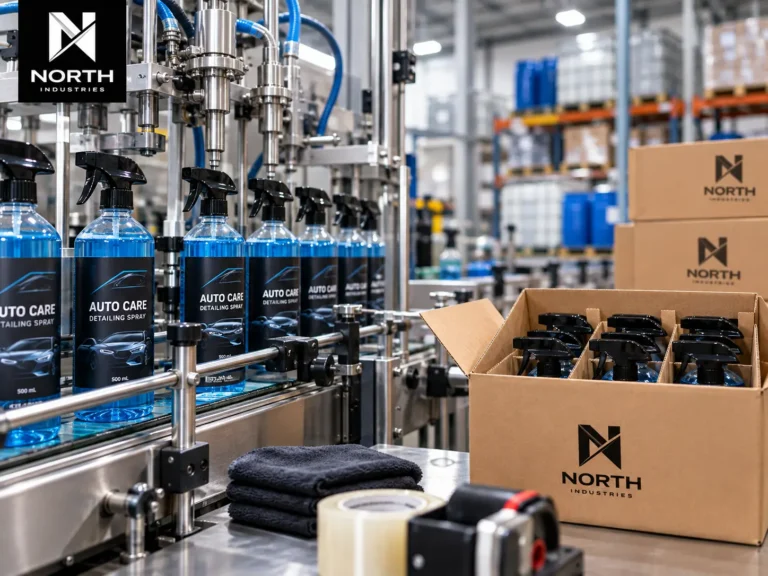
A car care liquid’s chemical classification decides whether a general co-packer can take it, and the same classification shapes what the label must show. A detailing brand with a product selling well on Amazon faces that classification check when it looks for a co-packer to fill larger runs of its existing formula. Automotive products co-packing in Ontario starts with the product’s safety data sheet (SDS). An SDS is the document that records a product’s hazards and how to handle it safely. Three questions are worth settling before any quote: whether the co-packer understands chemical handling requirements, how Canadian labelling regulations apply, and what the minimum run is.
TL;DR
- What it includes: For a detailing or car care brand, automotive products co-packing in Ontario covers the work between a finished formula and stock ready to sell: filling, capping, labelling, packing, and, where needed, kitting, storage, and shipping.
- What fits: A general co-packer can take non-hazardous car care liquids, and each product’s safety data sheet shows whether a specialist co-packer is needed.
- Rules: Four sets of Canadian rules can apply: consumer chemical labelling rules, workplace hazard rules, federal packaging and labelling law, and federal limits on volatile organic compounds.
- Minimum run: Minimums vary by co-packer, and North Industries supports small first runs and trial runs before a brand commits to full volume.
- Channels: Finished stock can move from one building to Amazon, to dealers and retailers, or to online store customers.
What does automotive products co-packing include?
Automotive products co-packing includes filling a car care brand’s existing liquid into its containers, then capping, labelling, and packing it. Automotive product filling in Ontario is the core step, and the rest of the run is built around it. Kitting, bundling, palletizing, storage, and distribution can follow the filling run.
A co-packer is a company that fills and packs products for other brands. The brand supplies the formula, and the co-packer does not formulate it. North Industries quotes each project partly on the services needed after filling, so those steps shape the quote.
North Industries fills, caps, labels, and packs non-hazardous, water-based car care liquids to the brand’s formula and artwork. The filling step itself is covered in more detail under contract bottling and liquid filling.
What should a car care brand look for in a co-packing partner?
A car care brand should look for a co-packing partner with a clear, written process for chemical products. For car care co-packing in Canada, that process shows up in six places, from the co-packer’s stated product scope to whether storage and fulfillment share a building with filling.
- Clear scope: A written list of the classifications a co-packer can and cannot take tells you early whether your product fits.
- SDS review: Reviewing each product’s SDS confirms fit before a quote is issued.
- Documented instructions: Written instructions give the co-packer a fixed reference for every run.
- Approved labels: The co-packer should apply only the labels you approve, made from your artwork.
- Trial runs: A trial run checks fill, labels, and packaging on a short batch before full production.
- One roof: Storage and fulfillment in the same building as filling remove a trip between vendors.
North Industries applies the labels the brand approves, made from the brand’s artwork, and offers trial runs before full production. The same six points carry over to how to choose a co-packer in Ontario for other product lines.
Which automotive products need a specialist co-packer?
Automotive products classed as hazardous products or dangerous goods on their safety data sheet need a specialist co-packer with the matching certifications and handling systems. Many specialty chemical products fall in this group. Which classifications a co-packer is set up to handle is the first thing to settle, before any samples are sent.
“Hazardous products” is the term Canada’s Hazardous Products Act uses for workplace chemicals that meet its hazard criteria. Dangerous goods are products regulated for transport because of their hazards. The hazard identification and transport information sections of an SDS show which group a product falls into.
A general co-packer can take products that are not classed as hazardous products or dangerous goods. Products that need certifications or handling systems North Industries does not maintain are outside North Industries’ scope.
Can automotive chemicals be co-packed in Ontario?
Yes, automotive chemicals can be co-packed in Ontario by a co-packer whose systems and certifications match the product’s classification. North Industries takes non-hazardous, water-based car care liquids. North Industries confirms each product’s fit against its safety data sheet before quoting a run, so the scope question is settled before any production is booked.
Which Canadian regulations apply to automotive car care products?
Automotive car care products sold in Canada can fall under four sets of federal rules: the Consumer Chemicals and Containers Regulations, 2001 (CCCR, 2001), the Workplace Hazardous Materials Information System (WHMIS), the Consumer Packaging and Labelling Act, and federal limits on volatile organic compounds (VOCs). Which rules apply depends on whether a product reaches consumers, workplaces, or both.
- CCCR, 2001: These regulations cover consumer chemical products sold in Canada. A product’s classification decides its label and packaging requirements, including hazard symbols, warning statements, safety instructions, and first-aid statements, according to Health Canada’s CCCR, 2001 guidance. The regulations require no regulatory authorization or reporting.
- WHMIS: WHMIS covers hazardous products sold or imported for use, handling, or storage in Canadian workplaces, such as detailing shops. Safety data sheets must be in English and French under Health Canada’s WHMIS supplier requirements. Consumer products, as the Canada Consumer Product Safety Act defines them, are excluded from those supplier requirements.
- Consumer Packaging and Labelling Act: Prepackaged products must show the product’s identity, its net quantity, and the identity and principal place of business of the company that made the product or had it made for resale, under the Consumer Packaging and Labelling Act. A prepackaged product is one ordinarily sold to or used by a consumer without being repackaged.
- VOC limits: VOCs cause ground-level ozone and particulate matter, the two main components of smog. Federal VOC limits cover automotive and household maintenance products manufactured in or imported into Canada, according to Environment and Climate Change Canada’s VOC factsheet. The limits cap the VOC content a product’s formula can carry. The regulations also set record-keeping and product labelling requirements. The regulations’ schedule lists automotive wash, automotive brake cleaner, and automotive rubbing or polishing compound as regulated categories.
Products sold in Quebec also fall under the Charter of the French Language, which requires every inscription on a product and its packaging to be in French, as Lavery, a Quebec law firm, notes in its guide to labelling in Canada and Quebec. The brand owns its product classification, label content, and formula compliance. North Industries applies the labels the brand approves.
What are the labelling requirements for automotive products in Canada?
Prepackaged products sold to consumers in Canada must show their identity and net quantity in English and French, plus the name and principal place of business of the company they were made for. Consumer chemical products also carry the hazard symbols and warnings their CCCR, 2001 classification requires. Hazardous workplace products need WHMIS labels and a bilingual SDS.
The company’s name and principal place of business are the only elements allowed in either official language.
Is there a minimum run for automotive co-packing?
A minimum run for automotive co-packing depends on the co-packer and the project. North Industries quotes each project based on run size, container format, labelling, and the downstream services needed. North Industries supports four run types: small first runs, trial runs, pilot production (a short run that tests the full production process), and production overflow.
A trial run confirms fill, labels, and packaging before the brand commits to volume, and production overflow adds capacity when a brand’s existing production cannot keep up with orders.
North Industries offers flexibility for brands below the minimums of larger national operators.
How do automotive brands get co-packed products to Amazon, wholesale, and DTC customers?
Automotive brands can get co-packed products to Amazon, wholesale, and direct-to-consumer (DTC) customers straight from the building where the products were filled, when the co-packer also stores and ships stock. The channel each run feeds decides how it is packed, from FBA shipment cartons to dealer case packs.
North Industries ships finished stock from one inventory through these services:
- Amazon FBA prep: Stock is prepared for Fulfillment by Amazon (FBA), the Amazon program that stores sellers’ products and ships their orders.
- Dealer and retail replenishment: Restocking orders for dealers and retailers ship in case packs and on pallets. A case pack is a carton holding a set number of units.
- Shopify and DTC orders: Orders from Shopify, an online store platform, connect through Zoho Inventory, an inventory and order management system.
- Delivery: Company-operated vehicles deliver across the Greater Toronto Area (GTA) and Southern Ontario, and Canada Post, FedEx, and United Parcel Service (UPS) are coordinated for parcels and longer routes.
Can a co-packer also handle Amazon FBA prep for automotive products?
Yes, a co-packer that offers prep services can handle Amazon FBA prep in the same building where it fills the products. North Industries applies Fulfillment Network Stock Keeping Unit (FNSKU) labels, which are Amazon’s unit barcodes. North Industries also builds bundles and kits and packs FBA shipments, so stock does not travel to a separate prep centre.
Brands moving an Amazon product line can plan FBA prep at North Industries’ Mississauga warehouse alongside the filling run.
How does North Industries support automotive brands in Mississauga?
North Industries supports automotive brands from its facility at 3186A Lenworth Dr, Mississauga. North Industries reviews each product’s SDS and its hazard and transport classification before any quote is issued. Trial runs come before volume, and one relationship covers filling, storage, FBA prep, fulfillment, and delivery.
North Industries asks for these documents and details up front, so it can confirm the product fits its scope before quoting:
- Safety data sheet: The SDS shows how the product is classified and how it must be handled.
- Hazard and transport classification: North Industries uses the classification to confirm whether the product fits its scope.
- Label claims: The label claims describe what the product does and what the approved artwork will say.
- Sales channels: The channels you sell through decide how finished stock is packed and shipped.
Automotive and aftermarket-parts companies are among the customers North Industries serves. North Industries’ full capabilities run from filling and kitting to storage and delivery. Brands looking for a detailing product co-packer in the GTA can book a facility tour before they decide.
Before your next production run, request an automotive product co-packing consultation with North Industries.