
TL;DR
- Formula: A pet grooming brand keeps its formula, and an outsourced partner fills, labels, and packs the product.
- Rules: The claims on the label decide which Canadian rules apply, from consumer chemical labelling to drug or pesticide rules.
- Labels: A label’s required information is bilingual, though the company name and address may appear in one language.
- First run: A trial run, used where needed, checks the fill and finish before full production.
- Prices: Labelling starts at $0.35 per unit, filling is quoted per filled unit, and a scoped quote sets each final price.
For the founder of a pet grooming brand whose natural dog shampoo or coat spray sells well direct-to-consumer (DTC) but is still mixed at home, pet grooming product manufacturing in Canada starts with a finished, documented formula. From there, the label claims set the rules that apply, a trial run comes first where required, and production and shipping run from one building.
What does pet grooming product manufacturing involve in Canada?
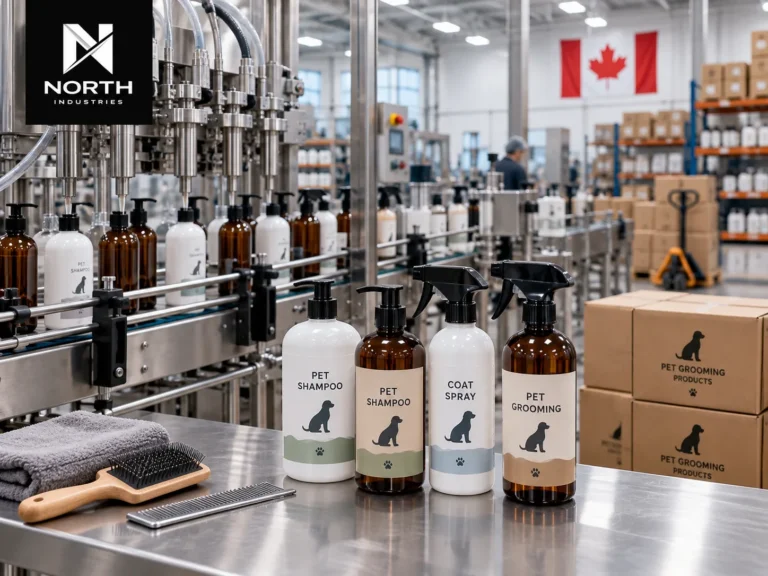
Pet grooming product manufacturing in Canada, when outsourced, means the brand supplies a proven formula and a partner fills, closes, labels, packs, stores, and ships it. The plain grooming products North Industries handles are shampoos, conditioners, detangling and coat sprays, and deodorizing sprays, all with no therapeutic, health-maintenance, or pest-control claims.
When brands outsource pet shampoo production, the partner that fills and packs to their specification is a co-packer, as explained in how co-packing works for growing brands. North Industries does not make pet food. Grooming liquids are one part of pet care manufacturing and fulfillment at North Industries.
Can a Canadian manufacturer produce pet grooming products?
Yes, provided the brand supplies the formula. North Industries fills grooming liquids into bottles, pump containers, and spray bottles, then fits the closures and applies the labels. Products with therapeutic or pest-control claims fall under separate Health Canada approval rules and sit outside North Industries’ scope.
Which Canadian rules apply to a pet shampoo or grooming spray?
Pet shampoo regulations in Canada depend on what the label claims. A plain grooming product follows federal packaging and labelling rules, plus consumer chemical rules when it carries a chemical hazard. A claim to treat a condition, control fleas and ticks, or maintain animal health moves the product into a different regulated category.
Each row pairs a type of claim with the rules it brings in.
Label claim | Example | Rules that apply |
Plain grooming | A shampoo that cleans and conditions the coat | Federal packaging and labelling rules, plus the Consumer Chemicals and Containers Regulations, 2001, where the product carries a chemical hazard |
Therapeutic | A dander-reducing cream | Veterinary drug, which carries a Drug Identification Number (DIN) once authorized |
Flea and tick | A flea and tick product applied to the skin | Pest control product registered under the Pest Control Products Act, with a Pest Control Product (PCP) number, or a veterinary drug with a DIN when sold as one |
Health maintenance | A product with vitamins or minerals that maintains animal health | Veterinary health product (VHP), with Good Manufacturing Practices (GMP) and notification before sale |
A grooming aid is legally classified as a drug if it makes any claims to modify body functions or to prevent or treat disease, according to Health Canada’s guidance on when a grooming product becomes a drug. VHPs are low-risk drugs used to maintain or promote animal health. Health Canada’s veterinary health product rules require companies to notify Health Canada at least 30 days before a VHP is sold.
This overview is general information, not legal or regulatory advice. A brand confirms its product’s classification with Health Canada or a regulatory consultant.
Does the CFIA regulate pet grooming products?
No. The Canadian Food Inspection Agency (CFIA) deals with pet food, and its oversight is limited to compliance with import and export requirements for animal products and by-products. Pet grooming liquids fall under Health Canada’s rules and the federal packaging and labelling rules.
What goes wrong on pet grooming product labels?
Irritant, toxicity, and pressurized-container labelling, along with inadequate classification documents, were among the failures Health Canada listed after evaluating 37 animal grooming products in 2020-2021. The inspections led to 10 recalls, 5 stop distributions, and 4 commitments to address non-compliance.
Health Canada checked the products against the packaging, labelling, and other performance criteria of the Consumer Chemicals and Containers Regulations, 2001, according to Health Canada’s compliance review of animal grooming products. Another 18 needed no corrective action. Health Canada does not consider these findings to reflect overall market compliance, because inspectors select the products more likely to fall short. Hazard labelling and classification documents are worth settling before labels are printed.
Do pet grooming labels need to be in English and French?
Yes. Mandatory label information appears in English and French. The name and principal place of business of the company by or for which the product was made or packaged may appear in either official language. The main panel of the label must show the net quantity and the product’s identity.
The product’s identity is its common or generic name or its function, as set out in Canada’s Consumer Packaging and Labelling Regulations. The Competition Bureau, a federal agency, enforces the labelling law for non-food products.
Will a manufacturer formulate my product or confirm its ingredients are pet-safe?
North Industries does not formulate pet grooming products or confirm that their ingredients are safe for pets. Formulation and ingredient safety stay with the brand or its formulator. North Industries produces to the brand’s specification and reviews the product’s documents to confirm it is a plain grooming product that suits the facility.
The review covers the ingredient list, the label claims, and the safety data sheet (SDS), the document that records a product’s hazards and how to handle it safely. Because the review checks fit rather than pet safety, the brand’s formula and safety work need to be complete first.
Does a pet shampoo need a GMP-certified facility?
A plain pet shampoo with no health claims is not a veterinary health product (VHP), so Health Canada’s Good Manufacturing Practices (GMP) requirement for VHPs does not apply. The GMP requirement, in Part 3 of the Natural Health Products Regulations, covers companies that manufacture, package, label, import, distribute, or store VHPs. The brand confirms the classification first.
What should you send a filling partner before the first run?
A filling partner needs the product’s documents, packaging details, and sales plans before a first run, because these settle whether the facility can take the product and what the run will cost. Each item either confirms the product’s classification or sets part of the quote.
These documents and details belong in the first inquiry:
- Ingredient list: The ingredients show whether the product stays a plain grooming product.
- Label claims: A claim to prevent or treat disease makes the product a drug.
- Safety data sheet: The SDS shows whether a chemical hazard brings in consumer chemical labelling rules.
- Container and closure: The bottle, pump, or trigger sprayer sets the filling and capping work.
- Label artwork: The artwork shows which labels, stickers, or barcodes the labelling work covers.
- Expected run size: The number of units is an input to the quote.
- Sales channels: The channels decide how stock is packed, from case packs (cartons holding a set number of units) to Amazon shipments.
How does a first pet shampoo production run work?
North Industries takes a first pet shampoo production run through a set sequence, from the first inquiry to delivery. The product, price, and schedule are settled before production begins. The process typically takes one to eight weeks depending on scope. Larger projects can take longer.
- Initial project inquiry
- Product and process review
- Sample, specification, or site meeting
- Labour, material, and equipment assessment
- Trial or test run where required
- Formal quotation
- Client approval
- Deposit
- Production scheduling
- Execution
- Quality review and delivery
North Industries handles pet brand manufacturing in the Greater Toronto Area (GTA) from one Mississauga facility, where trial runs and full production take place. The filling step in dog shampoo manufacturing is covered under contract bottling and liquid filling.
Can a small pet brand start with a small batch or trial run?
Yes. North Industries supports small-batch pet shampoo production, trial runs, and pilot production, with flexible onboarding below national providers’ minimums. A trial run is a short batch made before full production to check the fill, finish, or box layout. Pilot production is a short run that tests the full production process before volume production begins.
What does it cost to fill, pack, and ship pet grooming products?
North Industries prices pet grooming work by the unit for packing, by the order for fulfillment, and by the month for storage. Filling is quoted per filled unit and has no published price. Packing work starts from $0.15 per unit.
North Industries’ starting prices are in Canadian dollars (CAD).
Service | Starting price (CAD) |
Labelling | From $0.35 per unit |
Contract packaging | From $0.15 per unit |
Kitting and bundling (combining separate products into one set) | From $2.00 per unit |
Subscription box assembly | From $6.00 per box |
Pick and pack (collecting each DTC order’s items from stock and packing them for shipping) | From $4.50 per order, plus $1.00 per additional item |
Fulfillment by Amazon (FBA) prep | From $1.50 to $2.50 per unit |
Pallet storage | From $25 per pallet per month |
Final-mile delivery (the last leg of a shipment) | From $150 |
A pet care product consultation turns these starting prices, and the price for each filled unit, into a scoped quote.
How do pet brands ship DTC, subscription, and Amazon orders from one inventory?
One inventory can serve DTC, subscription, and Amazon orders when the building that stores the stock also packs and ships for each channel. At North Industries, a single stock pool in Mississauga serves every channel, so stock is not split across separate warehouses.
Orders from Shopify, an online store platform, connect through Zoho Inventory, an inventory and order management system. Retail and wholesale orders ship in case packs. North Industries also runs company-operated final-mile delivery.
A surge in demand for Canadian-made products is reported in Packaged Facts’ Canadian Pet Market Survey, a market research report based on a bilingual September 2025 survey of 1,000 Canadian pet owners.
What prep do pet grooming products need before shipping to Amazon FBA?
North Industries prepares pet grooming products for Fulfillment by Amazon (FBA), the Amazon program that stores sellers’ products and ships their orders, starting from $1.50 to $2.50 per unit. The prep covers Fulfillment Network Stock Keeping Unit (FNSKU) labels, which are Amazon’s unit barcodes, and shipment builds, where units are packed for delivery to Amazon.
Carton labels and pallet builds for Amazon shipments are also part of Amazon FBA prep in Canada.
Can a 3PL assemble subscription boxes for a pet care brand?
Yes. At North Industries, a third-party logistics (3PL) provider in Mississauga, subscription boxes are assembled in the same building where the brand’s stock is stored. Box assembly starts at $6.00 per box. Packaged treats can go in as sealed items only.
Gift sets and inserts such as cards and coupons are part of kitting and assembly for subscription boxes.
Request a pet care product consultation with North Industries before your next home batch.