
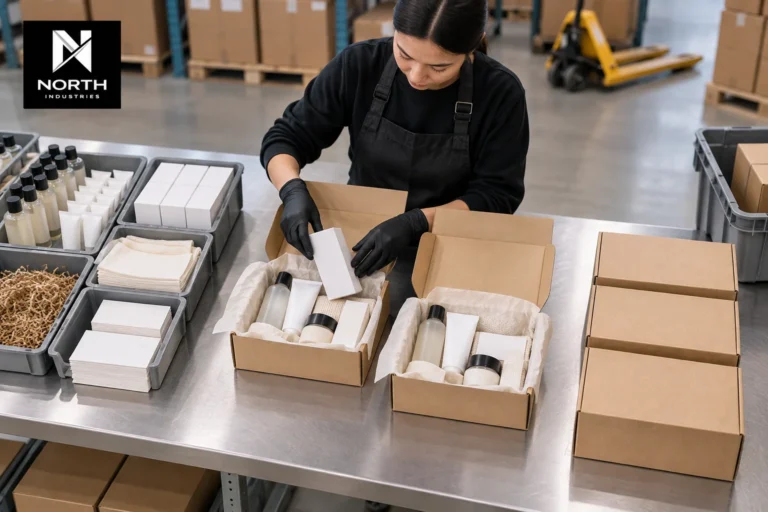
If you are a subscription box founder, a bundle creator, or a brand running promotional kits, kitting and assembly services in Ontario let you hand the repetitive work of building finished kits to a fulfillment partner, so you stop assembling boxes on your kitchen table on weekends. Kitting combines multiple products or components into one finished, sellable unit. This guide covers what kitting and assembly involve, which businesses use them, what they cost, how quality holds across every box, and what to look for in a partner before you sign.
The short version
- Kitting and assembly combine multiple products or components into one finished, sellable unit, built by a fulfillment partner instead of by your own team.
- Who uses it: subscription box companies, bundle and multipack sellers, promotional and gift-kit brands, and Amazon sellers building multi-item listings.
- What it costs: North Industries starts kitting and bundling at $2.00 per unit and subscription box assembly at $6.00 per box, scoped to a quote for your specific kit.
- Quality on every box comes from a documented quality check and a first sample approved before the run, plus reconciling your components against the kit spec before assembly begins.
- The biggest saving is kitting and fulfillment in the same building, so kits are built, stored, and shipped with no handoff between separate vendors.
What are kitting and assembly services, and how do they work?
Kitting and assembly services combine multiple products or components into a single finished unit that is ready to sell or ship. A fulfillment partner receives your items, assembles them to your specifications, checks quality, and packages the result. The point is straightforward. The repetitive build work moves off your team and into a warehouse set up to do it accurately at volume.
The two terms overlap. Kitting is the grouping of separate SKUs into one kit, such as a subscription box or a retail bundle. Assembly is the light hands-on work of putting a multi-part product together, inserting cards, folding, sealing, shrink wrapping. In practice, they run side by side, and a good partner handles both so that separate items arrive as one finished, branded unit without creating extra work for your internal team.
Which businesses use kitting and assembly services?
The businesses that use kitting and assembly are the ones shipping products that come in more than one piece. If your customer opens a box with several items inside, someone has to assemble it, and outsourcing that work is what kitting exists for. The most common users share the same problem: manual assembly that does not scale.
- Subscription box companies, assembling curated boxes to a fixed product list every cycle.
- Bundle and multipack sellers, grouping two or more products into one retail unit.
- Promotional and seasonal kit brands, building marketing kits, sample sets, and limited runs.
- Gift-set brands, assembling boxes with inserts, tissue, and finishing touches.
- Amazon sellers, combining items into a single sellable listing for FBA.
How does subscription box kitting work, and why is it operationally complex?
Subscription box kitting is the recurring assembly of a curated box to a fixed product list, built and shipped on a schedule. Each cycle, components are received, boxes are assembled to the kit spec, every box is quality-checked, and the run ships to your subscribers. The hard part is holding that consistency at renewal volume, month after month, when a single missed insert multiplies across hundreds of boxes.
Consistency is the fear every subscription founder knows. The way a professional partner protects it is with a documented quality check on the build and a first sample approved with you before the full run starts, so the standard is set on box one and repeated on box six hundred. Because the boxes go out from the same facility that assembles them, the build and the shipping stay under one roof rather than crossing between a packer and a separate courier.
What kinds of kits can you outsource: bundles, promotional sets, and gift boxes?
Beyond subscription boxes, almost any multi-item build can be outsourced. North Industries assembles kits, bundles, and promotional packages, combining separate products into one finished unit. The common formats fall into three groups, and each carries its own packaging and finishing needs.
- Retail bundles and multipacks, grouping related products into one shelf-ready or listing-ready unit.
- Promotional and seasonal sets, built for a campaign, a launch, or a holiday window.
- Gift boxes, with inserts, tissue, ribbon, and higher-touch presentation.
This is different from co-packing, which packages a single product line into its retail packaging rather than combining several products into a kit. If your need is packaging one product at production scale, that is co-packing. If it is combining several items into one sellable unit, that is kitting.
How does Amazon FBA kitting work, and what are the requirements?
Amazon FBA kitting means assembling multiple items into a single unit that ships to Amazon as one sellable SKU, then prepping it to Amazon’s rules. That covers building the bundle or multipack, poly-bagging where required, applying FNSKU and any suffocation warning labels, and packing to Amazon’s carton and weight requirements. Getting the prep right is what keeps the shipment from being flagged or refused at the fulfillment centre.
FBA kitting and FBA prep run together. The kit is built, then labelled and packed to specification for inbound shipping. North Industries prices Amazon FBA prep from $1.50 to $2.50 per unit, and the same team can build the multipack and prep it in one pass. For the full inbound process, see North Industries’ Amazon FBA prep in Mississauga.
How much do kitting and assembly services cost?
Kitting and assembly are usually priced per finished unit, per component handled, or per project hour, plus a one-time setup for the first run. Standardized kits with a predictable build suit a per-unit rate. Complex or variable assembly is often quoted by the hour. North Industries publishes starting prices for each, and the final rate is scoped to your kit.
Service | Starting price |
Kitting and bundling | $2.00 / unit |
Subscription box assembly | $6.00 / box |
Amazon FBA prep | $1.50 to $2.50 / unit |
Assembly projects | $75 / hr |
Quality control and inspections | $75 / hr |
Contract packaging | $0.15 / unit |
Labelling | $0.35 / unit |
These are starting points. The price for your run depends on the number of components, the assembly steps, the packaging, and your volume, which is why a scoped quote gives you a real number rather than a guess.
How much does kitting cost per unit?
Kitting is priced per finished unit for standardized kits and per hour for complex or variable assembly. At North Industries, kitting and bundling start at $2.00 per unit, subscription box assembly at $6.00 per box, and larger assembly projects at $75 per hour. Because kit complexity and component count vary widely, the exact per-unit price is set by a quote for your build.
What should you look for in a kitting partner?
The kitting partner to choose is the one that protects your quality and removes work, not simply the lowest per-unit rate. A cheap rate on a poorly run line costs more once you count reshipped boxes and unhappy subscribers. Weigh the partner on how they handle accuracy, flexibility, and communication before you weigh them on price.
- A documented quality-control process, with a first sample approved before the run.
- Accuracy on every unit, because subscription and gift buyers notice a single mistake.
- Flexibility for a growing brand, including trial and pilot runs so you are not locked into a large first commitment.
- Direct access to the people running your account, rather than a portal and a ticket queue.
- Warehousing and shipping under the same roof, so nothing changes hands between separate vendors.
How do you hand off your products and assembly instructions?
You hand off a kit spec, or bill of materials, that lists every component and how the kit is built, then ship your components to the partner. Before assembly, a capable partner reconciles what arrived against the spec, so any shortfall surfaces before the run rather than midway through it, and approves a first sample with you so the finished box matches your intent.
How does North Industries handle kitting and assembly in Mississauga?
North Industries handles kitting and assembly in Mississauga as one part of a single fulfillment relationship. North Industries assembles kits, bundles, promotional packages, and subscription boxes, then warehouses, preps, and ships them from the same building, on company-operated delivery across the Greater Toronto Area. Your kits are built and shipped without a handoff, and without adding work to your team.
That single relationship is the difference for a subscription or bundle brand carrying recurring volume. Instead of coordinating an assembler, a warehouse, and a courier, and absorbing the cost and delay each time product changes hands, you work with one partner that builds and ships from one place, with trial and pilot runs available so you can start at a manageable size. You can see everything North Industries runs under one roof on the capabilities page, and when you are ready, request a kitting quote or book a tour of the Mississauga facility.
Frequently asked questions
- What is the difference between kitting and bundling?
Bundling is a type of kitting. Bundling usually means grouping a few related products into one package to sell together, such as a two or three-item set. Kitting is the broader term for combining any components into a finished unit, from a simple bundle to a multi-item subscription box or a promotional kit with inserts, packaging, and finishing. - Can a 3PL do subscription box fulfillment?
Yes. A 3PL set up for it can assemble your subscription boxes to a fixed spec, quality-check each one, store the components, and ship the run to your subscribers on schedule. North Industries assembles subscription boxes and ships them from the same facility, so the build and the delivery happen under one relationship rather than across separate providers. - How much lead time do I need for a kitting run?
Lead time depends on kit complexity and volume. Once your components and kit spec arrive, a straightforward, repeatable kit can be set up and running quickly, while complex kits that need sampling or custom packaging take longer. North Industries scopes the timeline to your project, so confirm it when you request your quote.