
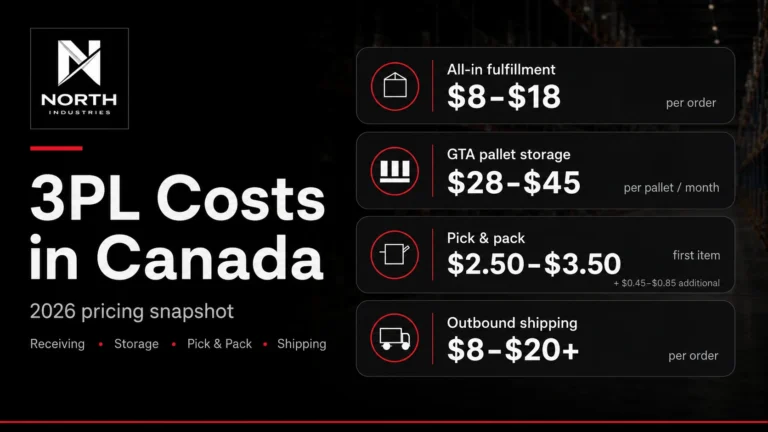
If you have quotes from three 3PLs and they look nothing alike, the problem is not you. Providers itemize differently, so the same operation can read as $8 an order at one and $15 at another. Here are the real 2026 numbers. All-in 3PL fulfillment in Canada runs about $8 to $18 per order before carrier shipping, once receiving, storage, and pick-and-pack are combined. In the Greater Toronto Area, racked pallet storage runs about $28 to $45 per pallet per month, higher than the national average because GTA warehouse space is the most expensive in the country.
TL;DR
- Per order: all-in fulfillment runs about $8 to $18 before carrier shipping. Cross-border orders run about $11 to $19 once customs handling is added.
- GTA storage: racked pallet storage is about $28 to $45 per pallet per month, above the national average of roughly $18 to $25.
- Pick and pack: about $2.50 to $3.50 for the first item and $0.45 to $0.85 per additional item in the GTA.
- The budget-wreckers: account minimums, packaging materials, long-term storage surcharges, and a Q4 peak uplift of 20 to 25 percent, usually absent from the headline quote.
- North Industries prices line by line from your actual volume rather than a flat rate, and routes to a real quote through the contact page.
How much does 3PL fulfillment cost per order in Canada?
All-in 3PL fulfillment in Canada runs roughly $8 to $18 per order before carrier shipping, combining receiving, storage, and pick-and-pack. Cross-border orders run higher, about $11 to $19, once customs handling is added. The figure moves with order volume, item count, and product size, so the per-order cost falls as volume rises and simple single-item orders cost less than multi-item ones.
The per-order number is useful for planning, but it hides the components underneath it, and those components are where two quotes diverge. The table below sets out the 2026 Canadian ranges for each cost line, with GTA figures called out separately where local rates run above the national average.
Cost line | 2026 CAD range | Basis |
Setup and onboarding | $200 to $1,000 | one-time |
Receiving (inbound) | $32 to $48 GTA ($10 to $13 national avg); container $350 to $500 | per pallet or container |
Pallet storage | $28 to $45 GTA ($18 to $25 national avg) | per pallet per month |
Pick and pack | first item $2.50 to $3.50; additional $0.45 to $0.85 | per order plus per extra item |
Outbound shipping | $8 to $20+ | per order, carrier-dependent |
Returns processing | $2 to $6 | per return |
Account minimum | $800 to $3,500 | per month |
Q4 peak surcharge | +20 to 25% | seasonal, on pick-pack and labour |
Long-term storage | +25 to 100% on pallets aged past 180 days | surcharge |
Do 3PLs charge setup or onboarding fees?
Most Canadian 3PLs charge a one-time setup fee of about $200 to $1,000 to integrate your store, configure inventory, and map your SKUs. It covers the work of getting your account live and running. Some providers reduce or waive it for longer contracts or higher volumes. Ask what the fee includes and whether any of it credits against future billing.
What are 3PL receiving fees?
Receiving fees cover unloading, checking, and putting away inbound inventory. In the GTA, palletized receiving runs about $32 to $48 per pallet, while the national average sits nearer $10 to $13. Full-container unloading is usually quoted separately at roughly $350 to $500. Loose or unpalletized cartons that need sorting cost more, because they take more labour per unit received.
Receiving is worth scrutinizing because it is billed on the way in, before you have sold anything. A provider that charges a high per-pallet receiving rate and a high monthly minimum can be expensive for a brand that receives large, infrequent shipments. Ask how receiving is billed for your typical inbound format.
How much does pallet storage cost in the GTA?
In the Greater Toronto Area, racked pallet storage runs about $28 to $45 per pallet per month in 2026, above the national average of roughly $18 to $25. GTA rates sit at the top of the Canadian range because Toronto-area industrial space is the most expensive in the country, driven by proximity to Pearson, the 400-series highways, and about a third of Canada’s population within a day’s ground transit.
Storage is not always billed per pallet. Depending on how your inventory sits, a provider may bill by square foot, by cubic foot, or by bin, which can work out cheaper for small, high-SKU, or vertically stackable inventory. Watch for long-term storage surcharges, which many warehouses now apply to pallets that sit past 180 days to discourage dead stock from tying up space.
What is a fair pick and pack fee in Canada?
A fair GTA pick-and-pack fee in 2026 is about $2.50 to $3.50 for the first item in an order and $0.45 to $0.85 for each additional item. The base fee usually covers picking the item, packing it, and applying a standard shipping label. B2B or case picking for retail compliance is priced differently, often per case. Packaging materials are frequently billed on top rather than included.
What does 3PL shipping cost?
Outbound shipping is usually the highest single cost per order, running about $8 to $20 or more depending on carrier, destination, speed, and parcel weight. Most 3PLs pass carrier rates through, sometimes at a discount earned from their shipping volume. Shipping is quoted separately from fulfillment, which is why per-order fulfillment figures normally exclude it. When you compare providers, confirm whether they mark shipping up or pass it through at cost.
What are returns and reverse-logistics fees?
Returns processing runs about $2 to $6 per returned order in Canada, covering inspection, grading, and either restocking or disposal. Restocking fees may apply on top. Returns are easy to leave out when comparing quotes, but for apparel or other high-return categories they add a real recurring line, so factor your actual return rate into any per-order estimate.
What do value-added services cost?
Value-added services are billed by labour or by unit. Kitting and assembly run roughly $0.35 to $0.45 per touch plus an hourly rate around $40 and up, and labelling or barcoding about $0.10 to $0.40 per label. These cover work beyond standard pick-and-pack, including bundling, retail-ready packaging, and relabelling. A provider that also handles co-packing and packaging can run these in the same facility that stores and ships your goods, which avoids a separate vendor and a second freight move.
What is a 3PL minimum monthly charge?
A minimum monthly charge is a floor a 3PL bills when your storage and activity fall below a set threshold, commonly about $800 to $3,500 per month in Canada. It exists so the provider covers account management and integration on smaller accounts. Many national 3PLs also will not onboard a brand below a 25 to 50 pallet minimum at all, which prices out smaller and growing brands before they start. Ask where the minimum sits and how close your projected volume runs to it.
Why are my 3PL invoices higher than my quote?
Invoices run higher than quotes when costs land that were not in the headline rate. The common ones are account minimums, packaging materials at about $0.50 to $2.00 per order, long-term storage surcharges on aged pallets, and a Q4 peak-season uplift of roughly 20 to 25 percent on pick-and-pack and labour. None of these are necessarily unfair, but undisclosed ones are the single most common source of 3PL buyer frustration. For the full list of charges to check a quote against, see the guide to hidden 3PL fees in Canada, and if the pattern is chronic, the signs your 3PL is failing.
How do I compare 3PL quotes properly?
Compare 3PL quotes on total cost of ownership, not headline rates, because providers itemize differently. Rebuild each quote into the same cost lines, apply your real monthly volume, and add the fees that only appear later. A provider with a higher pick rate but no minimum and no peak surcharge can cost less overall than one that looks cheaper on the first page.
Here is a worked GTA example for a DTC brand shipping 1,000 orders a month, averaging 1.5 items per order, holding 10 pallets of inventory, at mid-range GTA rates:
Line | Calculation | Monthly |
Storage | 10 pallets × $30 | $300 |
First-item pick | 1,000 × $3.00 | $3,000 |
Additional picks | 500 × $0.65 | $325 |
Receiving | ~4 pallets × $40 | $160 |
Packaging materials | 1,000 × $1.00 | $1,000 |
Returns (at 5%) | 50 × $4 | $200 |
Subtotal, excluding shipping | ~$4,985 | |
Shipping (pass-through) | 1,000 × $12 | ~$12,000 |
Excluding shipping, that works out to about $5 per order for this high-volume, simple-SKU profile. Smaller or more complex operations sit higher, toward the $8 to $18 all-in range. The example also shows why shipping deserves its own scrutiny: at roughly $12,000, it dwarfs every fulfillment line combined.
What does North Industries charge, and how is pricing structured?
North Industries does not publish a flat rate card. Pricing is built line by line from your actual volume and scope, using the same components above: receiving, storage by pallet position or square foot, pick-and-pack, value-added work, and account minimums where they apply. The reason is that North combines manufacturing, packaging, warehousing, 3PL fulfillment, and company-owned final-mile, so a quote reflects the specific mix you actually use rather than a generic average.
What your cost depends on is straightforward: your order volume, your SKU count and product size, how much handling each order needs, your storage footprint, and whether you use value-added or manufacturing services. What you get for it is a single accountable relationship. Because receiving, storage, fulfillment, and delivery sit together, you avoid the markups and handoffs of stitching several vendors into one supply chain, which is usually where hidden cost accumulates.
Two points matter for growing brands. First, North onboards below the 25 to 50-pallet floor most national 3PLs require, so you can start without paying for space you do not use. Second, as you scale, the same provider adds co-packing, kitting, or contract manufacturing without a fresh onboarding, so your cost tracks what your business actually needs at each stage. North sets measurable terms per account and quotes line by line, so the invoice matches the quote.
Frequently Asked Questions
- How much does pallet storage cost in Toronto?
Racked pallet storage in Toronto and the wider GTA runs about $28 to $45 per pallet per month in 2026, above the national average of roughly $18 to $25. GTA rates are the highest in Canada because industrial space near Pearson and the 400-series highways is in the most demand. Billing by square foot or cubic foot can lower the effective rate for some inventory. - What is the average 3PL cost per order in Canada?
All-in fulfillment averages about $8 to $18 per order before carrier shipping, combining receiving, storage, pick, and pack. Cross-border orders run about $11 to $19 once customs handling is added. The figure drops with higher volume and simpler orders, and rises with multi-item orders, oversized products, and low monthly volume. - How is 3PL pricing calculated?
3PL pricing is calculated by component rather than as a single rate: storage by pallet or space, receiving by pallet or container, pick-and-pack per order and per item, plus value-added work and any account minimum. Each component is mapped to your actual volume, which is why an accurate quote requires your order count, SKU count, and inventory footprint. - Is 3PL pricing negotiable?
3PL pricing is often negotiable, particularly on per-order rates as volume rises, and sometimes on setup fees and minimums. Providers discount because higher, predictable volume lowers their cost to serve. The clearest way to improve a quote is to share accurate volume figures and ask the provider to price against them rather than a generic tier. - What is a peak season surcharge?
A peak season surcharge is a temporary uplift most 3PLs apply during the Q4 rush, commonly 20 to 25 percent in the GTA, added to pick-and-pack and labour to cover surge staffing. It usually runs from around October into January. Ask whether a provider charges one and how much, because it can materially change your Q4 budget.
Ready for a quote you can actually compare?
If you have quotes that will not line up, the fix is a line-by-line breakdown against your real volume. Request a transparent quote or book a Mississauga warehouse tour through the contact page, and bring your monthly order count, SKU count, and inventory footprint so the numbers reflect your actual operation.