
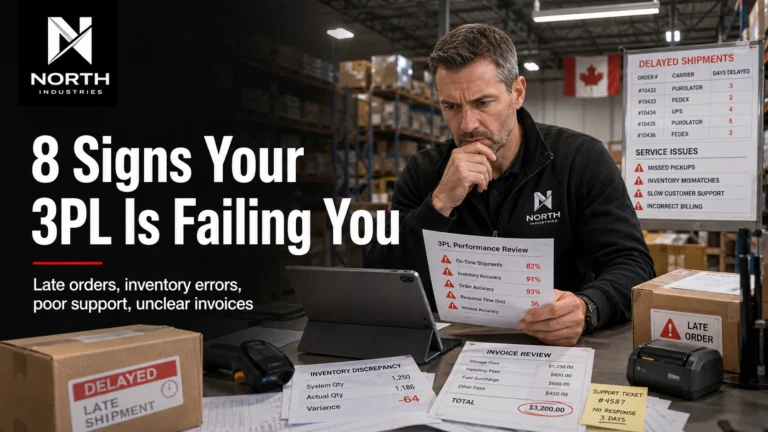
If you run operations for a growing brand and you have spent months feeling that your 3PL is letting you down, this article is a way to check that feeling against numbers. Most signs your 3PL is failing are measurable. Order accuracy below 99.5%, inventory accuracy below 98%, support you cannot reach within a business day, and stock that goes missing are not personal bad luck. They are gaps against industry benchmarks, which means you can show your CEO a case, not just a complaint.
TL;DR
- The measurable signs: order accuracy under about 99.5% and inventory accuracy under about 98% both sit below industry benchmarks.
- The human signs: support you cannot reach, invoices you cannot read, and an account manager who has gone quiet.
- The structural signs: service that collapses at peak, and inventory that will not sync with Shopify or Amazon.
- Why it matters: because most of these are numbers, you can justify a switch to leadership instead of arguing from frustration.
- What good looks like: direct access to the people running your account, line-item pricing, labour scaled to demand, and one accountable relationship. North Industries offers a no-obligation fulfillment review through the contact page.
Why can’t I reach a real person at my 3PL?
If reaching your 3PL means opening a ticket and waiting, and replies come from several people who all say they are looking into it, that is a red flag. A capable provider responds to urgent issues within about four hours and gives you a named contact who owns the problem. When support is an overseas email queue with no owner, small issues become customer-facing ones before anyone acts.
The pattern in real reviews is consistent: merchants describe support that lives entirely in email, several replies from different people with no resolution, and an account manager who stops responding once things go wrong. Response time is the earliest warning because it predicts how every other problem will be handled. Ask your provider what their target response time is for an urgent issue, and whether you have one accountable contact or a shared inbox.
Why is my 3PL invoice full of charges I don’t recognise?
When your monthly invoice carries more line items than your order sheet, and charges like special handling, peak surcharges, or unexplained labour keep appearing, your costs are drifting away from what you were quoted. A reliable 3PL stays within roughly 10% of quoted rates and can explain every line. If you need to reverse-engineer your own bill, the pricing model is working against you.
Reviews frequently describe pricing raised without notice, storage billed at well above market rate, and receiving fees that do not match the agreement. The problem is rarely the existence of accessorial fees, which are normal. The problem is fees that are undisclosed or that change without warning. Ask for a full fee schedule and compare three consecutive invoices against it.
Why don’t my 3PL’s inventory counts match my records?
If your records and your 3PL’s counts never agree, the provider’s inventory accuracy is below standard. The industry benchmark is 98% or higher, and best-in-class operations run at 99.9% through regular cycle counts and barcode scanning at every touchpoint. A provider that only finds discrepancies when a problem surfaces, rather than through routine counts, is not protecting your inventory data.
In practice, brands describe emailing about discrepancies every week and waiting weeks for an inventory report that should be available on demand. Inventory accuracy underpins everything downstream, because a system that shows stock you cannot actually ship causes oversells and cancellations. Ask how often your provider cycle counts and what their reconciliation process is when counts do not match.
Why are my orders late when my 3PL says nothing is wrong?
Consistently late orders paired with the claim that nothing is wrong is a sign your 3PL cannot see or will not admit its own performance gap. The standard is same-day shipping for orders placed before the daily cut-off, and on-time shipping at 98% or higher. If picking takes 24 to 48 hours during a normal, low-volume week, that is a warning sign, not a busy patch.
The revealing detail is who discovers the delay. A strong provider flags an exception before it reaches your customer. A failing one lets you find out when a buyer complains. Ask for on-time shipping data by week, and ask your provider to tag the reason for any missed ship date so the number points to a cause.
Why does my 3PL fall apart during peak season?
If service is acceptable for most of the year but collapses during peak, your provider is not forecasting volume or staffing to demand. Orders that normally ship in one to two days stretching to four or five during high volume is the most common seasonal failure, and it usually traces back to poor labour planning rather than a one-off spike.
Peak is a test of whether a provider scales with you or caps out. This is where a fulfillment partner that adjusts labour to confirmed demand, including seasonal and overflow support, behaves differently from one running a fixed crew. Ask how your provider staffs for peak, and what their ship times looked like during last year’s busiest weeks.
What happens when a 3PL loses my inventory?
When inventory goes missing with no explanation, you are dealing with both a physical control problem and a financial one. Reviews describe hundreds or thousands of units unaccounted for, no root-cause explanation, and reimbursement capped far below production cost. Missing stock forces you to cancel orders and apologise to customers for errors that are not yours.
Two things separate a controlled operation from a chaotic one: whether client inventory is assigned and organised separately with controlled access, and whether the provider runs regular counts that catch loss early. It is also worth confirming who insures the goods and what the provider’s liability actually is, because many contracts cap or exclude it. Treat the contract’s liability language as information to verify, not legal advice.
Why won’t my Shopify or Amazon inventory sync?
If your storefront shows stock that your 3PL sold out of days ago, the integration is failing, and you are carrying ghost inventory. Modern sync should be near real-time, updating within minutes through a direct connection. Providers relying on daily batch uploads or manual updates cannot support a high-volume store, and the result is oversells and cancelled orders that damage your marketplace standing.
Accurate visibility depends on the systems behind it. At North Industries, inventory is managed in a connected system with Shopify and Amazon integration and direct reporting to the client, rather than a manual spreadsheet handed over on request. Ask your current provider how their sync works, how often it updates, and whether it is a direct connection or a scheduled file.
Why did the salesperson who signed me disappear?
If the person who sold you the contract vanished after signing and no one of equal seniority replaced them, the accountability you were promised did not survive onboarding. This is a structural failure, not a personality one. It means the relationship was built to close a deal, not to run your account.
The alternative is executive involvement that continues past the sale, where the people who scoped your account stay attached to it. A provider that passes you between departments after signing tends to repeat that pattern every time something breaks. Ask who will run your account day to day, and whether that person was in the room when your terms were set.
What should I do if my 3PL is failing?
If you recognise three or more of these signs, start by gathering the numbers: order accuracy, on-time shipping, inventory accuracy, response times, and your last three invoices against your quoted rates. That evidence is what turns an internal complaint into a decision your leadership can approve. It is also exactly what a credible replacement provider will ask to see. For the mechanics of moving without disrupting fulfillment, see the guide on how to switch a 3PL in Canada, and if you want a specific national comparison, the ShipBob alternative for Canadian brands.
North Industries approaches the account differently on the exact points that fail above. You get direct access to the people handling your inventory, including warehouse operations leadership, rather than a ticket queue. Pricing is quoted line by line so your invoice is readable. Labour scales to confirmed demand so peak does not break service. Manufacturing, warehousing, 3PL fulfillment, and company-owned final-mile sit in one accountable relationship. North Industries does not advertise blanket guarantees. It sets measurable targets with you once your volume is understood, which is the honest version of an SLA.
Frequently Asked Questions
What is a good order accuracy rate for a 3PL?
The industry benchmark for order accuracy is above 99%, and best-in-class providers run between 99.5% and 99.9%. A 3PL consistently reporting below 99.5% is underperforming relative to standard. At scale, the gap between 99.5% and 99.8% is the difference between roughly 50 and 20 errors per 10,000 orders, so the decimals matter.
What should 3PL inventory accuracy be?
The benchmark for inventory accuracy is 98% or higher, with best-in-class operations at 99.9%. Accuracy is maintained through regular cycle counts and barcode scanning at every touchpoint, not occasional full counts. A provider that only notices discrepancies when an order fails is not actively managing your inventory data.
How quickly should a 3PL respond to inquiries?
A well-run 3PL responds to urgent issues within about four hours and to general inquiries within the same business day. More important than speed is ownership: you should have a named contact who resolves the issue, rather than a shared inbox where several people acknowledge it and no one closes it.
What is a reasonable SLA for a fulfillment company?
A reasonable SLA sets measurable targets for order accuracy, on-time shipping, inventory accuracy, dispatch cut-off, and returns processing, plus regular reporting. Some providers, including North Industries, do not advertise blanket guarantees and instead agree specific targets per account once volume is understood. Written targets you can measure matter more than marketing promises.
Can I see real-time inventory at my 3PL?
You should have current inventory visibility, and modern sync with Shopify or Amazon updates within minutes through a direct connection. At North Industries, inventory is managed in a connected system with integration to your sales channels and direct reporting, rather than a manual file sent on request. Ask any provider how often their data refreshes.
Is a 3PL liable for lost or stolen inventory?
Liability varies by contract, and many 3PLs cap or limit financial responsibility for lost or damaged goods, which is why clients often insure their own inventory. Read the liability and insurance terms before signing, and confirm who carries coverage. This is general information, not legal advice, so verify your specific terms with a qualified adviser.
Ready to compare your provider against a real alternative?
If you gathered the numbers above and they confirmed what you suspected, the next step is a straightforward comparison. Book a no-obligation fulfillment review or a Mississauga warehouse tour through the contact page, and bring your accuracy, on-time, and cost figures so the review is grounded in your actual account.