
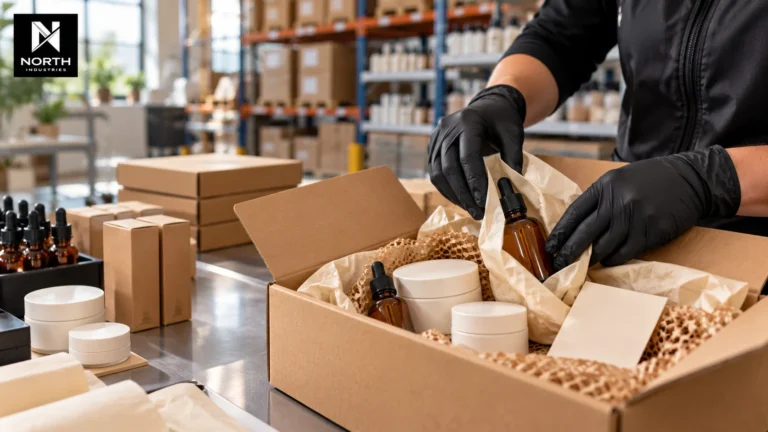
You have spent years on your formula, your bottle, and your box. Your real fear is a warehouse that treats your product like generic freight.
A third-party logistics (3PL) company stores and ships products for other brands. The right 3PL for beauty brands in Canada handles your product the way you specify. Storage should match the range your formula needs, and glass, droppers, and pumps should be packed to your own standard. A good 3PL should also be clear about which compliance duties stay with your brand.
Beauty and personal-care brands are among North Industries’ primary client segments. This guide covers what to check before you hand your product to any warehouse.
TL;DR
- What to look for: Choose a 3PL that works from your handling instructions and fits your current order volume.
- Storage temperature: Your product’s stability data sets its storage range, so ask every 3PL how it holds that range.
- Fragile packing: Make your glass packing standard the 3PL’s written procedure, and verify it with a test order.
- Filling: Some 3PLs can also fill and package your product in the same building, so nothing moves between vendors.
- Cost: Beauty fulfillment is priced as separate charges per order, per item, and per service.
What should beauty brands look for in a 3PL in Canada?
A 3PL for beauty brands in Canada should protect the work you put into your product. The right partner handles your product by your instructions, stores it within your formula’s range, and keeps the unboxing intact. It should also set clear rules for returns and compliance, and fit your order volume today.
Each criterion answers a specific fear:
- Handling built on your instructions: so your product is not treated like generic freight.
- A storage range matched to your product: so heat or cold does not change your formula.
- Presentation in the box: so every order opens the way you designed it.
- Channel coverage: so your website and Amazon draw on the same stock.
- Returns rules: so returned items are handled the way you decide.
- A clear compliance split: so you know which regulatory duties stay with your brand.
- Fit at your current volume: so a growing brand is not below the partner’s minimums.
A partner that meets only some of these criteria leaves gaps you have to manage yourself. That is the real test of cosmetics fulfillment in Canada.
Do cosmetics and skincare products need climate-controlled storage?
Whether cosmetics and skincare products need climate-controlled storage depends on each product’s stability data. Stability data means the test results that show how a formula holds up under different conditions. Your storage range comes from stability testing, so write the range down before you compare warehouses.
Heat can break down preservatives and let bacteria and fungi grow faster. Temperature changes, sunlight and air can also change a product’s colour, texture, and smell, according to shelf-life guidance from the Food and Drug Administration (FDA). The FDA is an American regulator, so treat its guidance as an explanation of how cosmetics break down, not as Canadian law.
The FDA treats setting a product’s shelf life as the manufacturer’s responsibility. Some companies test samples at different temperatures and humidity levels to see how each condition affects the product.
Give any skincare 3PL in Ontario your cosmetics storage temperature range in writing. Then ask how it holds that range in the warehouse and during winter transit.
How should a 3PL pack beauty orders so they arrive intact and on-brand?
A 3PL should pack beauty orders to the brand’s own standard, not to a generic warehouse method. The standard covers how fragile items are protected and how the box looks when it is opened. A test order should prove the standard works before real customers receive anything.
How are glass bottles, droppers and pumps protected in transit?
Shipping glass cosmetic bottles starts with a packing standard from the brand. The standard sets how each bottle, dropper, and pump is wrapped and separated. The 3PL turns that standard into its standard operating procedure (SOP), the written steps every packer follows. A test order runs before the account goes live, so the brand can check the result.
Can a 3PL add your inserts, tissue, and custom packaging?
Yes. Custom packaging for beauty orders can be built into a 3PL’s packing standard. North Industries handles custom packaging insertion, packing slips, and product inserts, following each brand’s specifications. If tissue wrap is part of your unboxing, add it to your packing standard so every packer applies it the same way.
Which beauty products count as dangerous goods for shipping in Canada?
Several common beauty products count as dangerous goods for shipping in Canada. Canada Post’s index sorts dangerous goods by hazard, and its beauty examples fall into three groups: pressurized, flammable, and oxidizing. Oxidizers are chemicals that can make a fire burn harder. Each product needs the correct classification before it ships.
Canada Post lists these beauty examples in its dangerous goods index for shippers:
- Pressurized: aerosol products such as hair sprays.
- Flammable: acetone in nail polish and remover, essential oils such as tea tree and eucalyptus, and perfume.
- Oxidizing: hair and textile dyes, and hydrogen peroxide.
Perfume shipping in Canada follows dangerous goods rules because perfume is listed as a flammable liquid. Canada Post notes that its index is not an exhaustive list. Confirm each product’s classification with its manufacturer or supplier, or contact the Canadian Transport Emergency Centre (CANUTEC). Then ask any 3PL how it ships dangerous goods before you send stock.
Can a 3PL handle gift sets, samples and subscription boxes for beauty brands?
Yes. A 3PL can assemble gift sets, sample packs, and subscription boxes when kitting is part of its service. Kitting means putting several items together into one packaged set before it ships. Beauty sample and gift set fulfillment works best when each set has its own assembly instructions.
North Industries assembles gift sets and samples through its kitting and gift-set assembly service, working from the brand’s specifications.
Can one 3PL fulfil Shopify, Amazon and wholesale orders for a beauty brand?
Yes. One 3PL can fulfil Shopify, Amazon and wholesale orders when every channel draws on one inventory pool. A single pool stops your website from overselling stock another channel already needs. Direct-to-consumer (DTC) fulfillment for beauty brands in Canada depends on that shared inventory count.
At North Industries, Shopify connects through Zoho Inventory, an inventory management system, and Amazon Seller Central and wholesale orders are supported alongside it. Amazon-bound stock also gets Fulfillment by Amazon (FBA) prep.
How should a 3PL handle beauty product returns?
A 3PL should handle beauty product returns by the brand’s rules, not its own. Each return is inspected, sorted, and then restocked or repackaged according to the rules the brand sets. Whether an opened item can be resold is the brand’s decision, and the 3PL follows it.
North Industries inspects, sorts, restocks and repackages returns based on each brand’s rules. Set a rule for each condition you expect, such as sealed, opened or damaged, before the first return arrives.
Who is responsible for Health Canada cosmetic notification when you use a 3PL?
Filing a Cosmetic Notification Form (CNF) with Health Canada is the manufacturer’s or importer’s duty, not the job of a 3PL that only stores and ships. The notification is due within 10 days of a cosmetic’s first sale in Canada, according to Health Canada’s notification guide. A missing notification can get a product denied entry or removed from sale.
A third party does not become the manufacturer or importer unless it meets the definitions in the Cosmetic Regulations. If no one in Canada meets the definition of manufacturer, the importer or any person who manufactures or processes the cosmetic in Canada is considered the manufacturer.
Labels changed in 2026. Since April 12, 2026, certain fragrance allergens must be listed as ingredients on the label and in the CNF. Stock labelled before that date may need relabelling, so review older inventory with a regulatory adviser.
This section is general information, not legal or regulatory advice, so confirm your obligations with a regulatory adviser.
Can a 3PL also fill and package your beauty products?
Yes. Some 3PLs also fill and package beauty products in the same facility that stores and ships them. Filling, co-packing and private-label production support under one roof means finished product does not move by freight between vendors. The formula still comes from your brand, because a filler works to your specification.
North Industries fills, co-packs, labels, stores and ships in one facility. North Industries does not formulate products, so your formula and specification stay with your brand.
A serum or oil can move from liquid filling for serums and oils straight into storage without leaving the building. Beauty product co-packing in Canada suits a product that already exists and only needs filling and packing; our guide to how co-packing works in Ontario covers the process.
How much does beauty fulfillment cost with a 3PL in Canada?
Beauty fulfillment cost with a 3PL in Canada is a set of separate charges, not one flat fee. Each order carries a pick-and-pack fee, and each extra item adds a smaller charge. Services such as kitting, returns and storage add their own lines. A scoped quote built on your real orders sets the final number.
The table shows North Industries’ starting prices for cosmetics fulfillment in Canada, in Canadian dollars.
Service | Starting price |
Pick and pack | $4.50 per order |
Additional item | $1.00 |
Kitting and bundling | $2.00 per unit |
Subscription box assembly | $6.00 per box |
Returns processing | $5.00 per unit |
Labelling | $0.35 per unit |
Amazon FBA prep | $1.50 to $2.50 per unit |
Pallet storage | $25 per pallet per month |
Each figure is a starting point. Carrier postage is quoted separately, and a scoped quote sets the price for your order profile.
How does North Industries support beauty brands in Mississauga?
North Industries supports beauty brands with handling procedures built from each brand’s instructions. Storage requirements are reviewed during scoping, the review of your needs before any quote. A test order runs before a new account goes live. Brands also get direct access to leadership and can visit the Mississauga warehouse before signing.
For founders comparing beauty brand logistics in Ontario, the support covers:
- Custom procedures: SOPs built from your packing standard.
- Storage review: storage requirements reviewed during scoping.
- Test order: run before your account goes live.
- Low minimums: onboarding below many national minimums.
- Leadership access: direct contact with the people who run the business.
- Warehouse visits: part of the sales process.
- One site: filling, co-packing, labelling, storage and fulfillment in one facility.
North Industries works with beauty oils, serums and other personal-care liquids, among the product categories it serves.
When your packing standard is ready, request a beauty brand fulfillment consultation.
Frequently asked questions
- What is the best 3PL for beauty brands in Canada?
The best 3PL for a beauty brand is the one that fits your product and volume. Look for handling built on your instructions, a storage range matched to your stability data and packing to your standard. Also look for a test order before launch, clear returns rules and minimums you can meet today. - Can a Canadian 3PL ship beauty products to the United States?
Yes, with two checks. Since August 29, 2025, shipments to the United States carry all applicable duties, taxes and fees, regardless of value, according to the Customs and Border Protection notice. FDA facility registration guidance excludes sites that only hold and distribute cosmetics, but not sites that fill them. This is general information, not legal advice. - Do I need a Canadian address to sell cosmetics in Canada?
Your cosmetic notification needs one. Since March 5, 2025, the Cosmetic Notification Form requires a Canadian address for the manufacturer or the importer, according to Health Canada’s notification guide. If your brand is based outside Canada, confirm which Canadian manufacturer or importer will appear on the form before your first sale. - How many orders a month does a beauty brand need to use a 3PL?
No fixed number applies across the industry. Each 3PL sets its own minimums, and some are built only for larger brands. North Industries onboards brands below the minimums many national 3PLs set, so you can start before your volume is large. Ask every 3PL for its minimum in writing. - Can I visit a 3PL’s warehouse before signing?
Yes, and you should ask any 3PL for a visit. Seeing the space shows you where your product will be stored and packed. North Industries includes warehouse visits as part of its sales process. Bring your packing standard, so the visit covers how your own product would be handled. - How long does it take to move a beauty brand to a new 3PL?
North Industries typically sets up 3PL accounts in two to six weeks. The range depends on integrations, inventory complexity and decision-making. A test order runs before the account goes live, so your first real orders follow a packing standard that has already been checked.